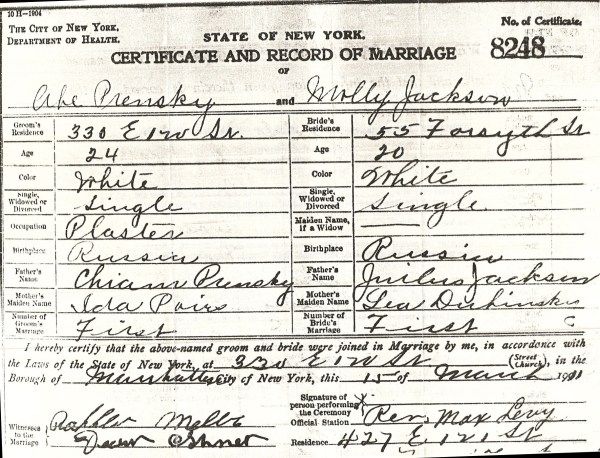
Abe Prensky and Molly Jackson Marriage Certificate – March 15, 1911
Doing Genealogical history. Some Notes
(Note – I would imagine that for other than people in my family line – and perhaps even they, what follows would be extremely boring (other than the first paragraphs). And while I am garnering personal details, actually I am as interested, in probing the social history of the families as finding out detailed facts about the family past. What was the world they left? I know that – it was pretty rough? What was it like for them living in the USA in the first half of the 20th Century?, etc). Anyhow I will continue to write about it.
1. Why do it?
First – what this is not about – I am not trying in any way to find some kind of “pedigree”, pure family line. I consider that racist bullshit and have no interest in it whatsoever. And I might add – as among us Jews one often hears something along the lines “Oh we’re all so smart – it must be genetic”…(not said so often but usually implied – occasionally said by more Orthodox types) …that too is nonsense. Racism has always cut two ways. On the one hand it stigmatizes some as being “inferior”, “lesser”, and as such opens the doors to what amounts to as exploitation up to and including crimes against humanity and genocide.
On the other hand, there is the “flip side”: those who really believe that they are “God’s gift to the world, “chosen people” (one of the more dangerous ideas floating around) – that they are smarter, better mentally or physically or both, have a genetic talent to be rich (that is what Carnegie and Rockefeller – two late 19th century Social Darwinist Robber Barons thought of themselves). Also a bunch of crap – a way to hide a life time of exploiting other human beings under the veil of genetics. So let’s forget that, cross it out, throw it in the garbage can, whatever. I am quite proud of my mongrel roots…broader gene pools = greater genetic diversity = what geneticists used to call “hybrid vigor” – fuck purity – another word for incest and the inheritance of all kinds of mental and physical diseases. Besides somewhere along the way we’re all mongrels. Read more…
Dutch Hegemony Time line

William of Orange – great Dutch radical and patriot. Fought for the freedom of religion against the Spanish Inquisition. A master political tactician and profound democrat
Dutch Hegemony Time line
785 A.D. – Charlemagne conquers the lowlands and adds them to his European Empire. Situated in a region with rivers, lakes, wetlands and woods, what became the United Provinces (and later the Netherlands) was a difficult area both in which to live and to conquer. It was one of the last regions of Europe that the Romans conquered. It was only in the 1st century BC that the Roman Empire was able to conquer the southern regions (around Nijmegen). Its northern regions were not conquered, not even invaded. Under Roman tutilege, the region began to prosper.
800-1200 A.D. – Charlemagne’s empire collapsed – as series of small kingdoms – dukedoms take form – some with German other with French nobles in charge.
Economically already, it continued to prosper. As Amsterdam.info notes:
After the fall of the Charlemagne Empire (he died in 814) the Low Countries territory has been divided into several smaller states – ruled by dukes and counts. At the same time, already in the Middle Ages, a strong economical development made the Netherlands one of the richest areas in Europe. Agriculture along with crafts and commerce, rich towns and important trading links reaching as far as Asia and North Africa, transformed the Netherlands into the area where the feudal power has been limited, safety of movement and economical activity established, sustained growth possible.
1000 A.D. – major work begins on building dykes – land reclamation
1100 A.D. – work begins in the region around Amsterdam.
1100s – Tanchelyn preaches in Antwerp – attacking the authority of the Pope and all other ecclesiastics, scoffing at the ceremonies and sacraments of the Church. Motley considers him a usurper. All Antwerp was his harem; he levied vast sums upon his converts; he organizes an armed guard of 3000 followers, executing all who resisted his commands; followers “drank the water in which he bathed and treasured it; he announced his approaching marriage to the Virgin Mary and then ordered his supporters to pay for the wedding expenses and his wife’s dowry. He was assassinated in 1115 by an obscure priest.
1100s – A series of heresies follow – the doctrines of Walden, Waldeneses, Albigenes, Perfectionsts, Lollards, Poplicans, Arnaldists, Bohemian Brothers “waged perpetual but unequal warfare with the power and depravity of the Church.” Nowhere was the persecution of heretics more relentless than in the Netherlands. In spite of the intense repression against the heresy, Waldo translated the Bible into French and then it was translated to Dutch ending the papal monopoly on being able to read and interpret the Bible.
1217 – Middelburg Charter – due process for all. local charters establish the limits to which a noble can bring charges against, arrest citizens of towns. An attempt to limit arbitrary violence against townspeople from the crown. Includes the following: – sets up a series of laws for fighting, disputes, – insists that everyone from nobility to homeless must go before the law (courts called “schepens”) – people accused of crimes will be tried in the town where they are accused”
1275 – trade between England and Holland, which had proceeded for centuries was interrupted by a ten-year trade war in which both sides engaged in piracy against the merchant ships of the other. Trade with the Mediterranean organized largely through the city of Bruges.
1275 – formal date for founding of Amsterdam
1300 – Already at this early date, the Dutch were engaging in intensified agriculture.
1386-1389 – The Lowland cities “thus advancing, in wealth and importance were no longer satisfied with being governed according to the law, and began to participate, not only in their own but in the general government.” – Assemblies of provincial estates are formed made up of both nobility and merchant classes. Went on for the following century with the six chief cities of Holland (Amsterdam, Gouda, Leyden, Dort, Haarlem, Delft) having the right to send representatives to regional assembly. Same was true of Flanders – ie …beginning of a strong regional democracy…with elected representatives. Read more…

Waterboarding…as American as apple pie? (source – Time Magazine – 1902)
Waterboarding. Turns out it is nothing new, not “invented” by George W. Bush, Dick Cheney and the lot of neo-conservatives who pushed the United States into an unending war against the Third World – from Afghanistan to Iraq and would like to see wars extended to Iran, Syria…and of late, Russia.
It was standard fare for the U.S. military in a Third World Country even 115 years ago: the torture of rebels, in this case waterboarding in the Philippines, 1902. The image on the left is a “Life” Magazine cover from May 22, 1902, on the website “Executed Today” in history, (today being April 5th). The website, which I discovered about a week ago, includes fascinating information concerning human inhumanity to its fellow beings through history.
Some entries are of a personal nature – so and so murdered so and so, etc, but many are distinctly political which interest me more admittedly. It’s not that I ignore such things – it has long given me the chills how people mistreat one another on an individual level. It’s just when states get involved – state sanctioned torture, murder – otherwise known as war – that things get even uglier.
There were two othe entries on the website though – besides the killing of Filipinos by torture – that especially caught my attention this April 5 – the guillotining of French revolutionary leader Georges Danton in 1794 and the execution of two Arab nationalists opposed to Ottoman rule in 1916, one in Beirut, the other in Damascus.
Concerning the U.S. invasion of the Philippines…If the occupation of Hawaii is discounted (the Hawaii-ans don’t discount it), or the many invasions of Mexico in the 19th Century (the Mexicans don’t discount them) the U.S. military invasion and occupation of the Philippines, Puerto Rico and Cuba as a result of the Spanish American War is considered the first foreign military intervention of the 20th century (even though they started in 1898). In the end a secret deal was cut between the Spanish and United States governments that rather than abandon these former colonies to their own people – punish the very thought of it!) that there would be a change of colonial rulers from Spain to the United States.
All three military occupations were messy, bloody affairs, but the one in the Philippines went on the longest and was probably the bloodiest. Some 200,000 Filipinos died opposing the U.S. military intervention. The intervention itself was overseen by U.S. General Arthur MacArthur, father of General Douglas MacArthur of World War II fame (and Korean War infamy – he was itching to using nuclear weapons against the Chinese and was removed from command by President Truman). Having honed his skills killing Indians on the Great Plains for decades, Arthur MacArthur went on to outdo himself in the Philippines where virtually everything that moved became target practice for the U.S. army.
According to one explanation for why the United States would invade the Philippines (that I recall reading a long, long time ago), then President McKinley – soon to be assassinated) explained that he made the decision to invade the Philippines at “God’s direction.” McKinley claimed to be undecided and was walking the White House floors agonizing over what to do when he heard a voice and the voice was God. Not having at the time the convenience of using t weapons of mass destruction nor military intervention for humanitarian reasons as pretexts, McKinley needed another line of reasoning to plunder a far away, Asian country. It was also a problem that there were not communist countries at the time that McKinley could argue were a threat to world peace intent on taking over the world.
A genuine dilemma!
But when all else fails, American presidents – from McKinley to George W. Bush can always take the Crusader logic of old, dust it off a bit, and go for it. McKinley would tell the American public, of all things, that God told him to invade the Philippines, and being a good Christian, how could he do otherwise? It is possible that besides consulting God, McKinley also conferred with some of the country’s main financial and corporate leaders of the day anxious to increase U.S. commercial ties with Asia, China especially, for which the Philippines would provide an excellent springboard. It was/is also a place extraordinarily rich in natural resources, a potential market in and of itself for the burgeoning U.S. manufacturing sector.
God told Arthur MacArthur to use waterboarding on Filipinos as he (it is a “he” usually, isn’t it?) instructed George W. Bush to do likewise on Iraqis, Afghans and who knows how many other Third World rebels. Blaming God for U.S. military intervention didn’t work so well for McKinley and the Philippine intervention also triggered one of the country’s great pacifist and anti-war movements. Calling a spade a spade, this peace movement called itself “The Anti-Imperialist League” whose prominent members included mega-capitalist Andrew Carnegie, Mark Twain, Jane Addams, John Dewey, William Jennings Bryan, William Dean Howells, William Graham Sumner, David Starr Jordan and former U.S. President Grover Cleveland. Unlike McKinley, apparently God had not spoken directly to these late 19th century American luminaries, either that or God was speaking in more than one voice – one to McKinley, a very different voice to Mark Twain and company.

CF&I Steel Mill – February 1976
On March 27, 2014 – the weekly program “It’s The Economy” on KGNU-Boulder interviews Bob Butero, United Mine Workers of America representative – and a former coal miner – along with Colorado State University prof and author Jonathan Rees, author of The Rockefeller Plan at the Colorado Fuel and Iron Company: 1914-1942. The interview runs about an hour.
In a few weeks, the 100th anniversary of the Ludlow Massacre will be marked by events all over the Front Range of Colorado. Most of them will take place south of Denver – in the Pueblo-Walsenburg-Trinidad region. Like the Triangle Fire Tragedy in New York City (March 25, 1911), the Ludlow Massacre of miners’ families working for the Colorado Fuel and Iron Company (CF&I) to provide coal and iron for the Pueblo, Colorado steel mill was a “watershed event” in the history of both the state and the nation. I will be posting a series of articles and writing up commentaries to commemorate this event and go into its implications over the course of the next few months.
The CF&I Steel Mill still exists. For a time it was the largest producer of steel between St. Louis and California. It has changed hands many, many times. The photo on the left is of the mill in the mid 1970s when it still employed – if I remember correctly – more than 6000 workers, then as in 1914 when the Ludlow Massacre took place, these workers coming from all over the world, with diverse backgrounds.

Finland – WW2 – More…
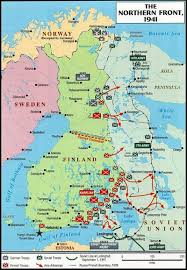
Karelian Front In WW2 north of Leningrad
This is a continuation of some thoughts on Finnish history based on the exchanges I had ten days ago with Ms Tytti concerning Finland’s role in World War 2. The exchange is found in the comments to the blog entry “Finland’s Jews – Some Reflections.’
First let me say that I appreciated her willingness to take the time to enter into a dialogue (of sorts) with me. The dialogue was a spin-off of an entry about Finland’s Jews who fought in the Finnish army in the early stages of the war on the side of Nazi Germany but ended the war in an alliance with the Allies, particularly the Soviet Union, with whom the Finnish government signed a treaty in 1944 that resulted in an end to the Finnish-Nazi alliance.
The history of the small central European countries in World War 2 caught as they were between Nazi Germany and the Soviet Union is complex and for the most part completely tragic. In the case of Finland, although it was allied with the Nazis its territory and military retained a certain degree of independence throughout. Nazi troops were stationed in the north of the country from where they launched military offensives into Soviet Karelia although most of Finland remained free of them.
Finland’s Jews – Some Reflections…
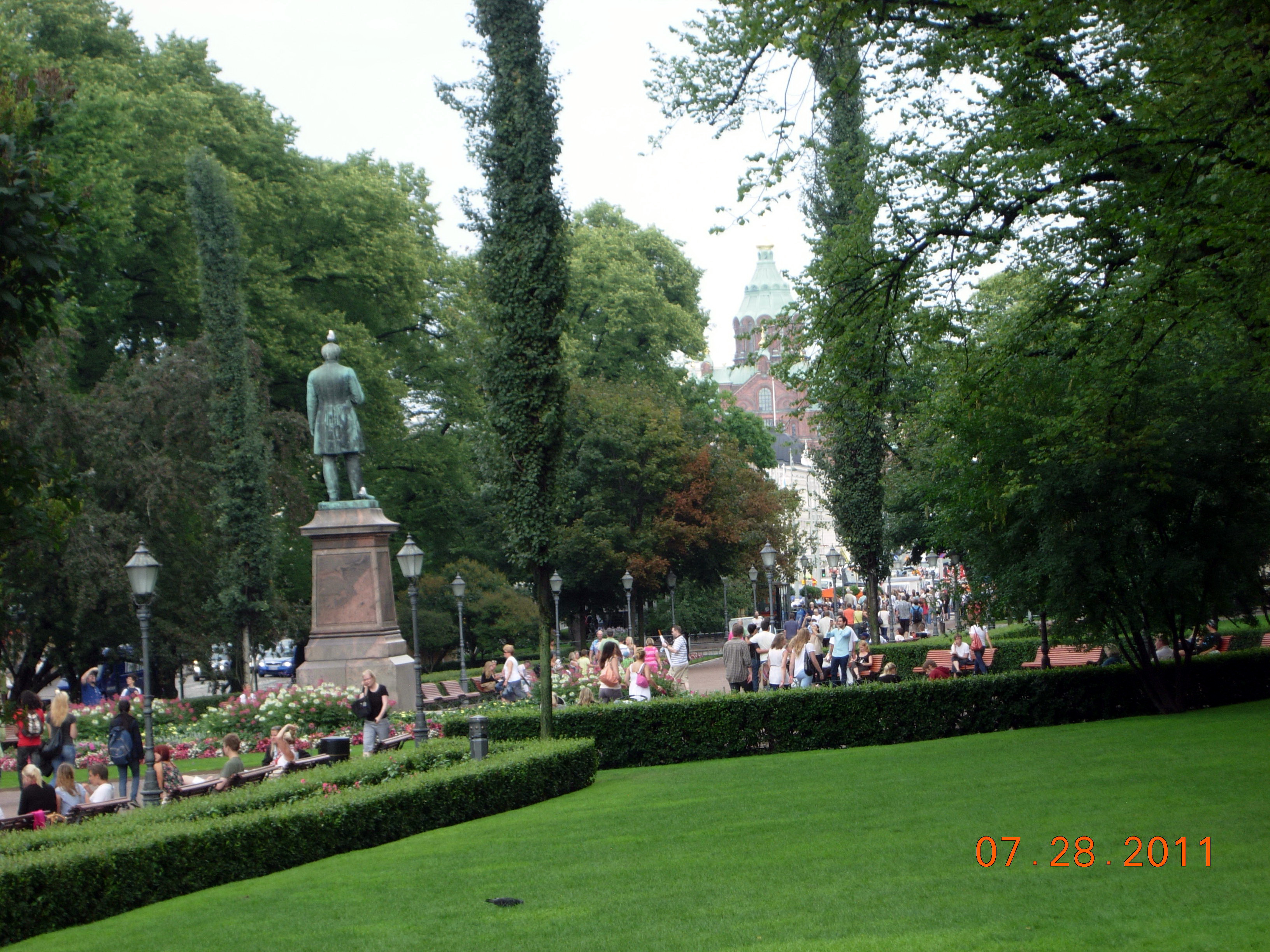
Esplanadi, Helsinki – Summer, 2011
A “Facebook friend” – perhaps I should just call him a friend – posted an article about he just found on Finland’s Jews – many of whom fought in the Finnish Army during World War Two. As the Finns were, until after the Nazi defeat at Stalingrad, allied with Nazi Germany, Finland’s Jews are among of the few Jews in World War Two who found themselves fighting side by side on the side of the Nazis.
In Finland it really isn’t a new story, but every once in a while some English-speaking researcher “discovers” the fact and writes it up as if it were news. This one is entitled “The Jews Who Fought For Hitler: ‘We Did Not Help The Germans, We Had A Common Enemy.” by Paul Kendall.
Quoted in the article is one John Simon. He notes ““I lived here for 25 years before I heard about it, and I’m Jewish,” says John Simon, a New Yorker who moved to Helsinki in 1982. “It’s not a story that’s told very much.” Perhaps Simon never heard of it, I don’t doubt that, but do find it a little odd, especially for some one who has long been interviewing Finnish war veterans from both the Winter War with the Soviet Union (1939-1940) and those who served in World War Two. Read more…
Rouen Chronicles: Amsterdam – 1965
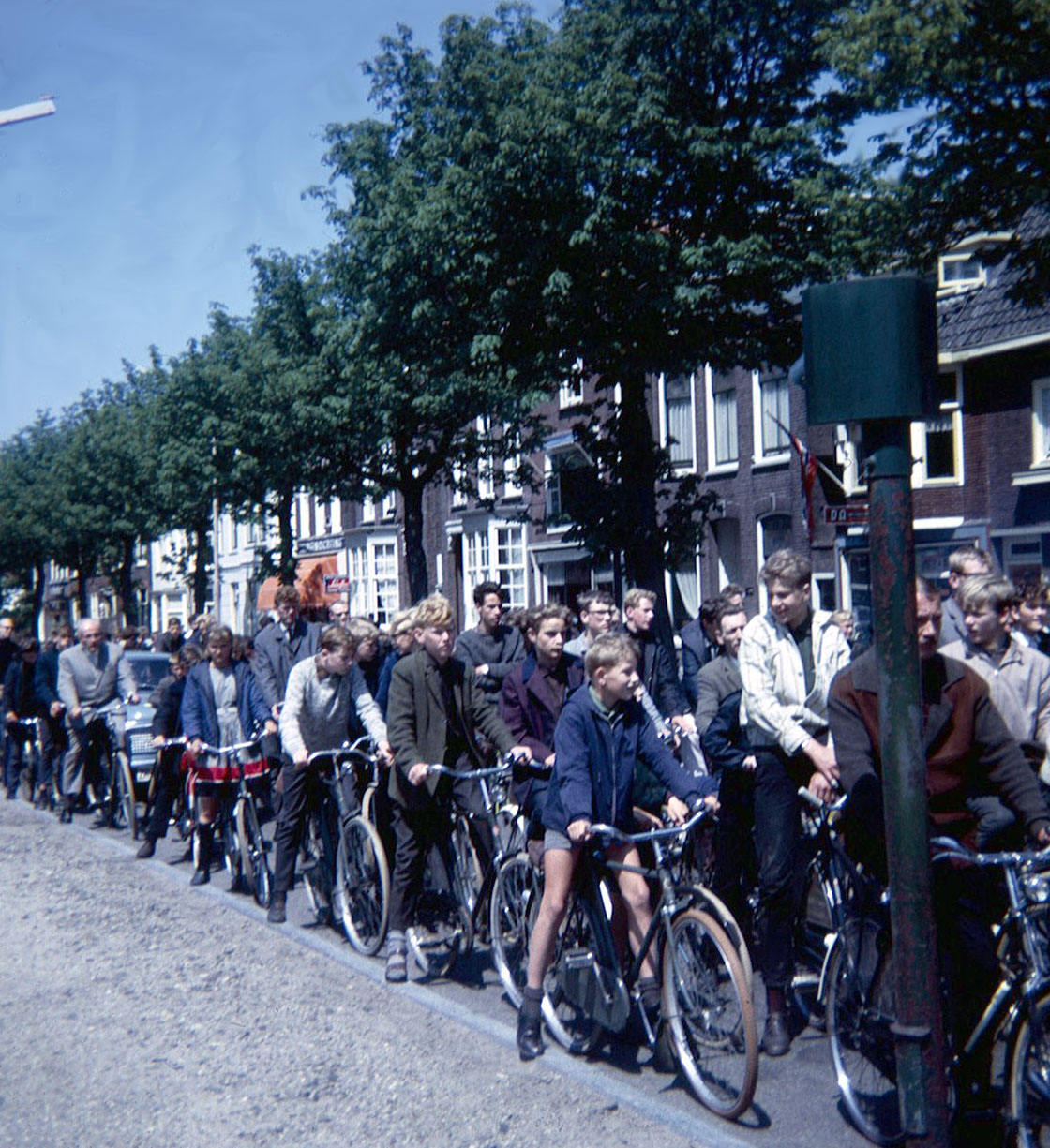
Amsterdam – Summer, 1965
Amsterdam…
A half century ago. June 1965. Well almost. Frank K. Kappler II and I drove into town in an Austin Mini and stayed for several days. We were roommates in Rouen, France for St. Lawrence University’s first Junior Year Abroad program (1964-1965). Rouen is that Norman commercial city where Joan of Arc was fried to a crisp by her British captors on May 30, 1431 and near where Flaubert’s Madame Bovary found life so boring 400 years later that she opted out for a series of empty affairs. At the end of the academic year, starting in mid-June, 1965, we took a memorable car trip through parts of Europe, that included a stop in Amsterdam.
I don’t remember where we stayed in Amsterdam and only vaguely recollect what we did: some museums, the Anne Frank house, a little trip to Gouda to see the cheese production there, the Heineken beer factory where they gave out samples, wandering through town, including in the red light district and along the canals. Not much remained really. The canals, the bicycles everywhere come to mind, not much else really. I took some pictures that fifty years later I sometimes look at for fun. Read more…
N.P.T. – Preserving Western Domination
 N.P.T.: Preserving Western Domination
by Ibrahim Kazerooni and Rob Prince
The latest negotiations between Iran and the U.S. (the so-called 5+2) for a long-term comprehensive nuclear agreement have ground to a halt. This is due to Washington’s last minute insistence to add new conditions to the talks to resolve “past and present concerns” about the “possible military dimensions” of the Iranian nuclear program. The U.S. and International Atomic Energy Association (I.A.E.A) charge is based on what the Iranians claim to be fabricated documents that neither Washington nor the I.A.E.A. are willing to share with Teheran for investigation. In his 2012 memoire, Mohamed El Baradei disclosed such documents to be a part of a whole series provided to Washington by Israel.[1] A cursory glance at the I.A.E.A., its tenets and philosophy will help clarity the essentially “colonial disputes” in the current situation. Read more…
Ukraine Revolt’s Dark Side
fine piece…let’s see – Syria, Ukraine and Venezuela – folks in Washington busy these days. i would be surprised if any of these crises worked in the Obama Administration’s favor…
Ukraine Revolt’s Dark Side
Dispatches From The Edge
Conn Hallinan
Mar. 2, 2014
“The April 6 rally in Cherskasy, a city 100 miles southeast of Kiev, turned violent after six men took off their jackets to reveal T-shirts emblazoned with the words “Beat the Kikes” and “Svoboda,” the name of the Ukrainian ultranationalist movement and the Ukrainian word for “freedom.”
–Jewish Telegraphic Agency,
April 12, 2013
While most of the Western media describes the current crisis in the Ukraine as a confrontation between authoritarianism and democracy, many of the shock troops who have manned barricades in Kiev and the western city of Lviv these past months represent a dark page in the country’s history and have little interest in either democracy or the liberalism of Western Europe and the United States.
“You’d never know from most of the reporting that far-right nationalists and fascists have been at the heart…
View original post 1,587 more words
In Defense of Sochi…

Denis Ten – Kazakhstan’s Bronze Medal Winner in Men’s Single Figure Skating at Sochi
(note – the attempt to smear and undermine the Sochi Winter Olympic Games failed. But it was not for want of trying)
by Manuel…
At the end the words for the Sochi Olympics was nothing short of magnificent. Russia won in all aspects, number of gold medals, total number of medals, security, organization, quality of venues and no one could deny it. No gay athlete or spectator was denied entry either!
Long before the games, the US corporate media (and to some extend BBC) launched one of its biggest propaganda campaigns to spoil the spirit of Olympics and scare people away from Sochi by exaggerating the “terrorist threat.” They equaled the Olympics to the person of Putin, thus wishing its failure. It sent a message that if you are in favor of these Olympics, you are pro Putin and Russia, our enemy! You are anti-gay. There was no excuse to boycott it or the media may have called for it too. They exaggerated the “corruption” and “waste.” We all know how uncorrupt true capitalism is, right and how far the west pushed to turn Russia back into a capitalist country? Read more…
Ukrainian capital going up in flames
For peace, against war: literary selections
7 policemen among 18 killed in Ukraine riots as Kiev city center burns
Protesters, Police Clash in Kiev, 10 Deaths Confirmed
Battlefield Kiev: Molotov cocktails rain down as rioters rough up police (VIDEO)
Ukrainian opposition besieges parliament building. LIVE UPDATE
Fresh riots in Kiev, violent clashes, tires burn downtown (PHOTOS, VIDEO)
Russia Accuses U.S. Of Dictating Events In Ukraine As Violence Flares

Unrest in Kiev is result of West’s connivance policy – Russian Foreign Ministry
Protesters, Police Clash in Kiev, 5 Deaths Confirmed
Kiev up in smoke as violence resumes in Ukraine capital LIVE
Fierce clashes in Kiev as new wave of unrest grips Ukraine

U.N. Report on North Korea: Providing The Pretext For Regime Change, East Asian Style?

North Korea
The headline from “Google News” – which I now read in the morning in lieu of the Denver Post – read graphically “UN: North Korea Like Nazi Germany”. Pretty powerful six words. It comes from the British newspaper, The Telegraph, with a picture of North Korean Kim Jung Un to boot to give readers a clearer image of “the modern-day Hitler.” The fact that the United Nations is making the claim, rather than the Obama Administration itself, adds weight to its legitimacy. If the UN is saying North Korea is like Nazi Germany – and this from the mouth of a retired Australian judge, Michael Kirby – then mustn’t it be true?
Kirby is referring to a 372 page United Nations investigative report that has just been published. The story is then picked up by The Telegraph (and many other news sources worldwide). It nails North Korea as a repressive dictatorship, a prelude to a campaign to bring charges against its leadership before the International Court of Law in the Hague – the call is already out there – and ultimately to justify what lies down the road: military intervention and regime change. No doubt, as it done elsewhere, such reporting amounts to little more than a global drumbeat for war using “humanitarian intervention” (with Cruise missiles) as a pretext for yet another Obama Administration call for war. Read more…
Military Humanitarian Intervention: the Shock Doctrine Applied to Syria
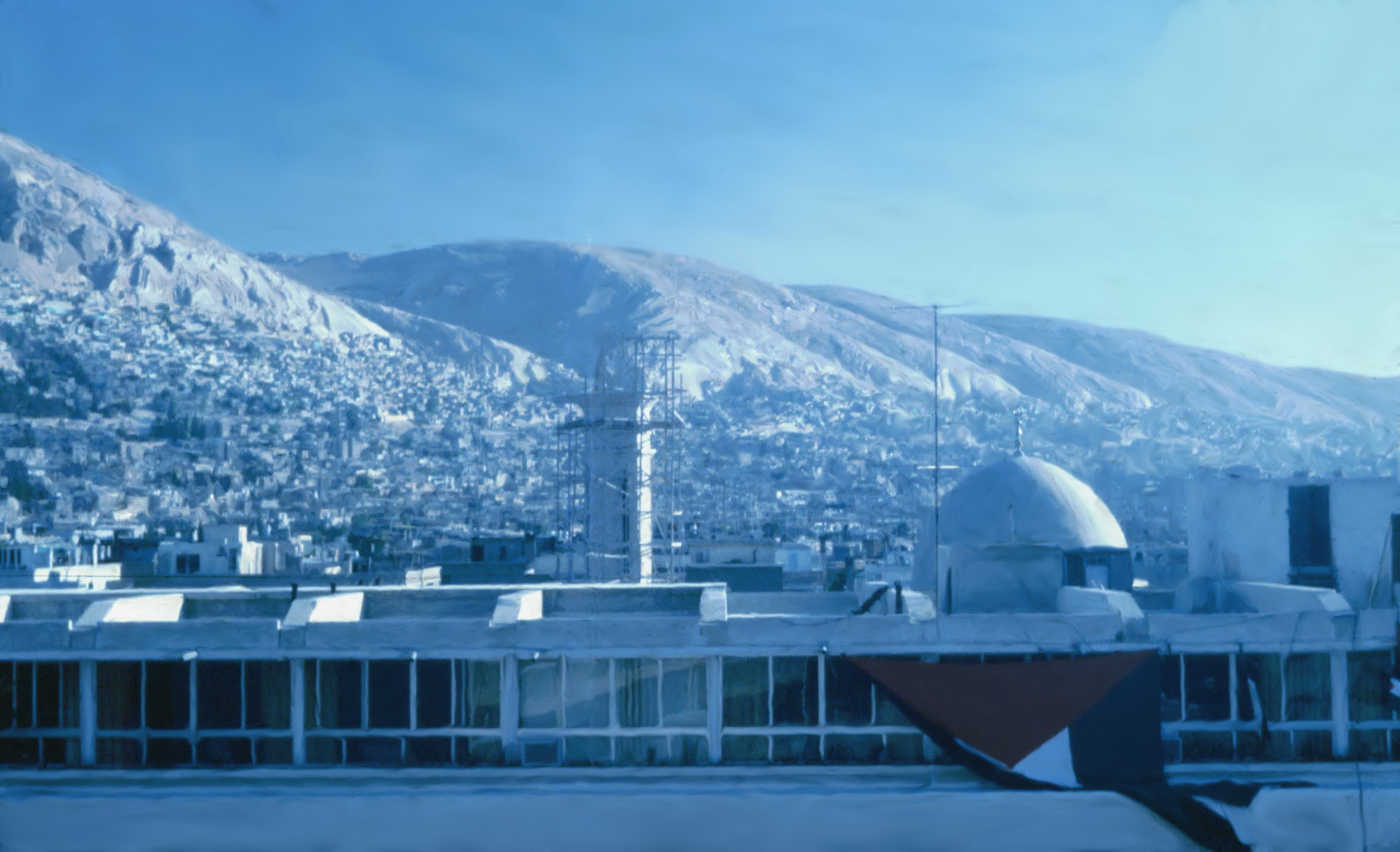
1981 – Syria – Damascus
(Note: This also appeared at Consortium News.com, Foreign Policy In Focus, Global Research , OpenNewsOpEd.Com and Portside)
Military Humanitarian Intervention: The Shock Doctrine Applied To Syria.
by Rob Prince.
(Note: Prince teaches at the Korbel School of International Studies. Although tangentially, he has been associated with the University of Denver’s Center for Middle East Studies and has participated in a number of its public forums, including on the Syrian crisis. Compelled to respond to the February 11, 2014 op-ed in the New York Times by colleagues, Nader Hashemi and Danny Postel, he critiques their arguments and makes alternative suggestions for ending the Syrian impasse.)
At a moment when the only viable path open to resolving the Syrian conflict lies in a negotiated settlement between the Assad government and the legitimate opposition, two colleagues at the University of Denver’s Korbel School of International Studies, Nader Hashemi and Danny Postel of the Center for Middle East Studies, have put forth an emotional and poorly conceived call for military intervention to resolve the escalating humanitarian crisis there.
Using logic tinted with Cold War reasoning (blaming the Russians is bit out of fashion) and poor examples (Somalia – 1993?) to bolster their arguments, they put forth their ideas on the subject in an op-ed, in the February 11, 2014 print edition of The New York Times “Use Force To Save Starving Syrians.” In a one-sided appeal, they place the blame for Syrian human debacle almost entirely at the feet of the Assad government for virtually all of the violence. Read more…
Timeline – European 19th – Early 20th Century Middle East Intervention and Middle East Uprisings
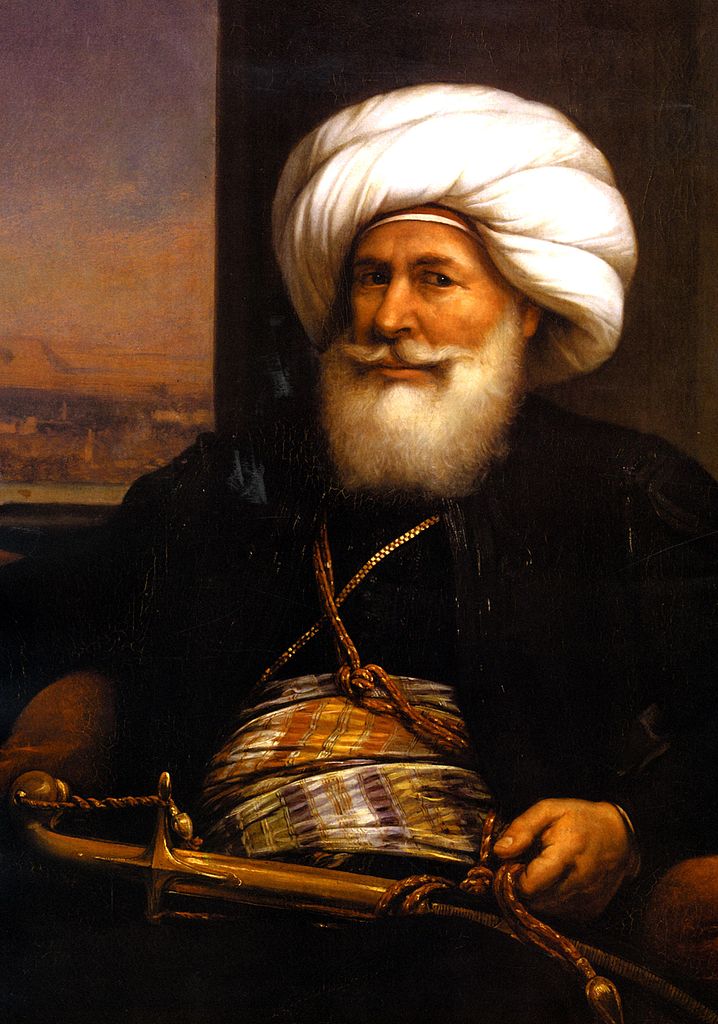
Muhammad Ali
1789 – Beginning already in the eighteenth century, rulers of British India began to make deals, sign treaties with Persian Gulf emirates like Kuwait and Muscat, supposedly vassals of the fading Ottoman Empire. But by this time British India treated the Gulf as a “proprietary lake and viewed the emirates as essentially underlings. The key to British influence was sea power. The East India Company began posting Residents in the Persian port of Bushire (today’s Bushehr). As British trade and influence grew, so did the power of Britain’s representatives, “Residents” in the Gulf. From Bushire, other Residents and Political Officers spread through the Gulf to “advise” sheikhs, sultans and emirs.
1796 – Charles Maurice de Talleyrand, a prominent politician, revolutionary and former priest argues before the National Institute (in Paris) that Republican France needed colonies in order to prosper. Pointing to British sugar production in Bengal, he implied that France needed to do likewise and that France should “also seek profits through colonial possessions that would produce lucrative cash crops.” (Cole, p.12). French control of Egypt could produce such a colony and also stimy British global influence by blocking the shortest route to India. So both French economic and strategic interests were at play. Napoleon was apparently impressed with his logic.
1799 – 1802 – Napoleonic Invasion of Egypt. Along with 30,000 French troops that he would soon, in a most cowardly fashion abandon to their own devices, Napoleon brought with him to Egypt many scholars, 150 artists and scientists, experts in many fields who would survey many aspects of Egypt’s ancient history, modern life, and fauna and flora – opening up not only Egypt, but what was then referred to as the Levant, today – the Middle East – to European scrutiny, a prelude to the European economic, political and military penetration and conquest of the region, wresting control from the already weakened Ottoman Empire.
As Andrew Oliver notes in his fascinating “American Travelers on the Nile: Early U.S.Visitors to Egypt, 1774-1839.”, ‘The savants were drawn from the Observatory in Paris, the Jardin des Plantes, the Ecole des Ponts et Chaussees, the Ecole Polytechnique and other institutions.”The work of these scholars would be published in the great Description de l’Egypte, a volume which “forever transformed the European and American understanding and appreciation for Egyptian antiquity.”
1799 – Battle of the Nile – French fleet destroyed by British of the coast of Alexandria, Egypt. Its supply lines to French Mediterranean ports cut, Napoleon is forced to withdraw in disgrace.
1806 – One Mehmet Ali (also known as Muhammed Ali), a Turkish speaking Ottoman of Albanian background, after shrewd negotiations with the Sultanate in Constantinople, becomes the pashalic of Egypt
1807 – A British fleet under one Admiral Duckworth sailed to Alexandria and landed an expeditionary force to forestall an expected French offensive in the Mediterranean. Local resistance led to a British defeat at Rosetta. Britain withdraws.
1811 – In March, Mehmet Ali invites a delegation of 60 Mamluks (military caste with allegiance to Constantinople) to dinner in Cairo. As they leave, he has all of the slaughtered in a narrow palace alley. In the aftermath several hundred more Mamluks are killed and their property pillaged. They cease to exist as competitors for power.
1811 – a little later that year, to feign allegiance to Constantinople, Mehmed Ali sent a military force to Arabia to purge Mecca and Medina of a fundamentalist Islamic sect, the Wahhabis (named after an 18th century Muslim scholar, Ibn al-Wahhab) which had taken over control of the holy cities of around 1803 and had refused to allow the Ottoman sultan’s annual offerings to Mecca and Medina. The war dragged on for six years but in 1817 Mehmed Ali’s forces were finally successful.
1813 – Treaty of Gulestan between Persia and Russia. The treaty confirmed inclusion of modern day Azerbaijan, Daghestan and Eastern Georgia into the Russian Empire.
1814 – The Treaty of Ghent is signed, ending the War of 1812 between the United States and Great Britain. It allowed Americans once again to travel abroad, including to what today is the Middle East. They begin to do so
1820-1830 – Greek revolt against Ottoman control Read more…
 View from the Left Bank: Rob Prince's Blog