In Boulder Colorado today (May 25, 2025) to see a play “The Israeli-Palestinian Conversation” directed and produced by Ami Dayan
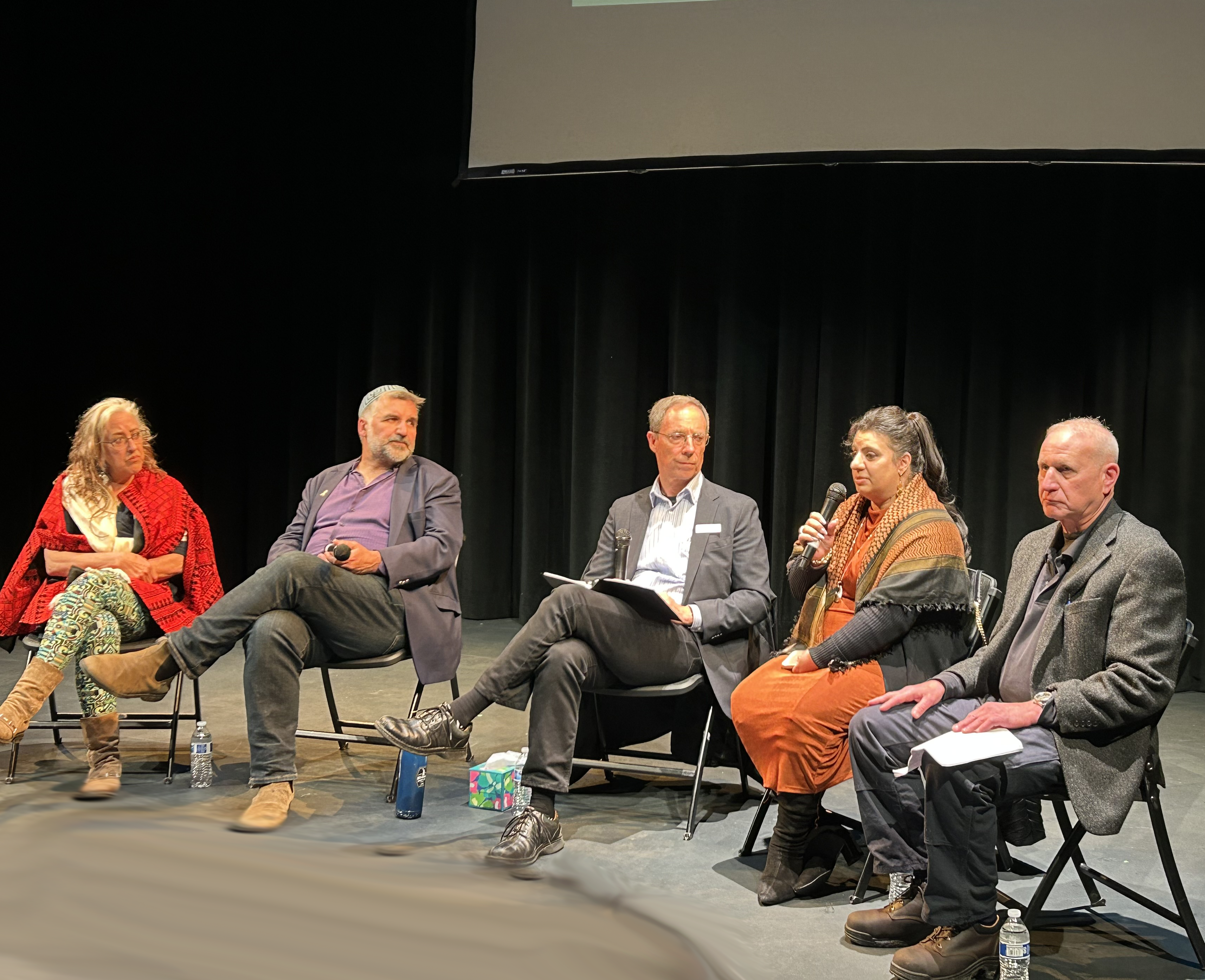
Panelists in the after-play discussion of “The Israeli-Palestinian Discussion” Boulder, Colorado at the Dairy Arts Center in Boulder. Play continues through next weekend
(Note: I have been informed by a reliable source that in fact there has been NO campaign orchestrated to shut down production of “The Israeli-Palestinian Conversation” and that therefore it is NOT NECESSARY to launch our own “defense campaign”. A little surprised, but glad to hear that at least in this case, free speech for Palestinian supporters, was not repressed. RJP)
In Boulder Colorado today to see a play “The Israeli-Palestinian Conversation” directed and produced by Ami Dayan. Well done, genuine dialogue, large Boulder Jewish Community presence.
Julia Halaby and Reema Wahdan represented their Palestinian people.
A few points I noted …
1. Although both Israel supporters (one a local rabbi, the other an Israeli exchange prof at C.U. Boulder) were critical of Netanyahu, the C.U. prof openly opposed an Israeli Palestinian ceasefire when asked. The two downplayed the ongoing genocide and suggested that everything was pretty much ok until October 7, 2023 when Hamas ruined it all. A lot of anti-Hamas rhetoric
2. The audience was told that it is “OK” to criticize Israel but a. cannot speak of genocide b. cannot call Israel racist c. cannot describe Israel as a settler colonial state and to do so is anti-Semitic.
3. Julia H, who participated in the play, was OUTSTANDING. Reema W., who participated in a panel afterwards, held her own very, very well. The two Israeli supporters kept their remarks – for the most part – limited to the events of October 7, 2023 – with little to no commentary on the decades that preceded the Palestinian breakout of Gaza and the attack on Israe.
FINALLY.
4. Such discussions are difficult but from where I’m sitting entirely necessary. We need more of such exchanges.
______________________________
Appendix A – Email from Ari Dayan, play producer to the Board of the Dairy Arts Center
To the Board and Leadership of The Dairy Arts Center,
I attended a recent performance of The Conversation and participated in the panel discussion that followed. What I witnessed was not provocation for its own sake, but a rare and vital example of what courageous public art can do: spark deep reflection, create space for multiple truths, and open doors to a conversation our community desperately needs.
I understand that The Dairy is now considering canceling the remainder of this production due to pressure from both Christian and Jewish Zionist voices. I want to speak directly to that moment of pressure—not as a neutral observer, but as someone deeply invested in the work and what it represents.
The irony is devastating. A play meant to spark a difficult but necessary reckoning is now itself the object of suppression. This moment reveals exactly the system the play attempts to name: a structure that does not tolerate critique, even in its most careful, humanizing form.
Let’s be clear: the backlash you are facing is not evidence of harm. It is evidence of discomfort—and discomfort is not a crisis. Silencing this work, however, would be. If The Conversation is too much for Boulder, then the problem is not the play. The problem is Boulder.
This is not a moment to back down. This is a moment to lean in. The play has already stirred deep and varied reactions in our community—grief, rage, reckoning, hope. That is what good art does. That is what you say you are here to support.
Cancelling this production would send a devastating message: that Boulder’s cultural institutions are only brave until they are pressured. That the boundaries of artistic freedom will be drawn by those who are most committed to silencing critique. And that our community cannot handle the complexity of a conversation we are already, undeniably, living inside.
If you follow through with cancellation, it will not be neutral. It will not be about “safety.” It will be about capitulation to those who have long maintained power by ensuring that Palestinian voices remain marginalized, and Jewish dissent stays silent.
This is your moment. Not to pick sides—but to confront a broader and increasingly visible truth: Boulder is not a neutral bystander. Our own city has adopted discriminatory policies that routinely displace working-class Black and Brown communities, push unhoused neighbors into invisibility, and protect privilege under the guise of civility. That context matters. Because when institutions silence critique in the name of comfort, they’re not promoting unity—they’re maintaining supremacy.
This is your chance to stand for the role of art, for the sanctity of public dialogue, and for a community that does more than perform progress—it practices it.
You’ve been asked for endorsements. Consider this mine—not just of the artistic merit of The Conversation, but of its rare willingness to hold complexity, to create a safe space for risk, and to elevate stories that are too often silenced. This is the kind of work The Dairy should be proud to present.
I hope you meet this moment with the courage it deserves.
Sincerely,
Micha
Trackbacks
- Both Sides-ism: The Battle of Narratives … Reframing and Softening the Israeli Occupation. Some Reflections on the play “The Israeli-Palestinian Conversation” playing at the Dairy Arts Center, Boulder, Colorado. | View from the Left Bank
- Both Sides-ism: The Battle of Narratives … Reframing and Softening the Israeli Occupation. Some Reflections on the play “The Israeli-Palestinian Conversation” playing at the Dairy Arts Center, Boulder, Colorado. | View from the Left Bank
 View from the Left Bank: Rob Prince's Blog
I saw the show on opening night (this past Thursday), and Reema Wahdan and Iman Jodeh were on the panel afterward, along with a CU Professor who had been in readings of last year’s How to Remain a Humanist After a Massacre in 17 Steps, an Executive of J-Street Colorado, and a Boulder Rabbi who is also a trauma therapist (sorry to be missing these names).
This piece–and the discussion afterward–were a considerable improvement over How to Remain a Humanist After a Massacre in 17 Steps (see above) by Israeli playwright Maya Arad Yasur. We in the Colorado Palestine Coalition expressed our dissatisfaction with that production to the management of the Dairy Arts Center. We were also quite clear that we were not advocating censorship or banning of performances, but the further erasure of the Palestinian narrative of the struggle.Art, including theatre, can contribute to understanding, dialogue, and even healing; justas it can provoke, agitate, and challenge. It can also flatter itself and its audiences that it is doing these things when in fact it is reinforcing received assumptions and contributing to the Hasbara that is allowing genocide. How to Remain a Humanist exhibited, for me, decidedly the latter tendency. While The Conversation is not free of this tendency, I agree with you that it is a step in the right direction. The Movement for Palestine must stand for freedom of expression especially in these times, not only as a value in its own right, but to further distinguish us from the oppressor.Terry BurnsedDenver
Hi Terry,
Thanks for your remarks.
What I saw was a chance for Palestinian voices to be heard unfiltered – both Julia’s in the play (well sort of play) and Reema’s in the panel discussion afterwards. The two pro-Israeli supporters, the rabbi and the prof, were both classic examples of liberal Zionism. I was not surprised at all with their contribution nor with Ami Dayan’s portrayal of a radical Zionist.
This morning (the day after first writing this) I learned that there is a concerted effort on the part of we-know-who to have the Dairy Cultural Center cancel the play. This offers the opportunity to defend the play in the name of defending free speech. The play itself is a quite moderate attempt at simple dialogue, yet this is too much for local Zionists.
Much of what you wrote above – your take – I share, still, I believe that what Reema and Julia did is what all of us should be doing more of – speaking to audiences with whom we are in disagreement, participating in programs – interviews, plays, writing articles – where we can present our views, ie, finding ways to break out of our isolation. Of course, we should think through – is this particular venue worth it? – Probably there are many that I would not be interested in. I thought Julia and Reema did a fine job – two seasoned Palestinian women whose voices came through pretty much unfiltered. From what I could tell, there were a fair number of Boulder Jewish folk in attendance that had to listen to Julia’s magnificent (I thought it was) presentation.
Cheers, hope all is well with you.
Rob
Thank you Rob for your 2 cents, and Terry for your comments!
This play has been so cathartic for me. For the first time in a lifetime of self censoring or being silenced, I get to speak loudly and clearly, even yell my truth. What a breath of fresh air. What a clean and expansive sensation in the chest. I cannot express the depth and breadth of my gratitude to everyone who has seen the play, plans to see it and who have supported my participation in it; it is scary and vulnerable.
I just want to be clear about the rumor of having the project shut down and I want to expose myself, for having biases and failing to maintain one of the four agreements; don’t make assumptions. Upon hearing that the Dairy received push back, without having had any details about when and how that pushback occurred I assumed it was from the Pro-Israel side of this topic. I still do not know details, but want to amplify that push back cannot be categorized as such. What is important for us to focus on is that there is a first step in giving space for the Palestinian voice, and that is commendable, and The Dairy Center needs to be thanked for that.
(Note: I recognize that for some of us who have been struggling on this for decades, it may be judged as peanuts, but even .5 is better than zero and is that much closer to understanding.) I also want to thank Terri B for his comments as well as for his asking repeatedly where the pushback was coming from- he, unlike myself kept a clear head. –Julia