Skip to content

D.U.’s Throwing Dr. Nader Hashemi “Under The Bus” – Goes National. Major story in MondoWeiss.

May 2, 2023

University of Denver criticized for violating Middle East scholar’s academic freedom

Dr. Nader Hashemi says the University of Denver blindly accepted Israel lobby accusations against him without due process. The AAUP agrees and says the university violated his academic freedom.

Earlier this year, Kenneth Roth, executive director of Human Rights Watch for almost 30 years, agreed to be considered for a fellowship at the Carr Center for Human Rights Policy at Harvard’s Kennedy School of Government but had the fellowship rescinded over his criticism of Israel. Days later, following widespread criticism, Harvard reversed the decision and claimed it had not been influenced by donors or Roth’s criticism of Israel.

Now, the University of Denver (DU) is embroiled in a similar controversy.

In August 2022, near the end of a podcast interview, Dr. Nader Hashemi, then Director of the University of Denver’s Center for Middle East Studies at the Korbel School of International Studies, was asked to speculate about possible motives behind Hadi Matar’s attempt on Salman Rushdie’s life. Against the background of the controversial Iran nuclear deal, Hashemi, a political theorist with impeccable credentials, offered three possibilities that might account for Matar’s vicious attack: that he might have been self-radicalized via the internet; that the Islamic Republic of Iran, never having revoked its fatwa calling for Rushdie’s death, might have prompted Matar; and that Israel’s Mossad might have been behind the attack as a false flag operation to derail US-Iran negotiations. All were reasonable speculations on the part of a Middle East scholar. But a coalition of Israel lobby organizations used Hashemi’s mention of Mossad to mount a vicious attack on his character.

Leaders of six Colorado Jewish organizations—Mountain States Anti-Defamation League, Hillel of Colorado, JEWISHColorado, Jewish Community Relations Council, Rocky Mountain Rabbis and Cantors, and Mountain States American Jewish Committee—released a statement demanding that the University of Denver “condemn Professor Hashemi’s statement which is damaging rhetoric masquerading as a legitimate opinion” and charging that “such statements put our Jewish students…at further risk.” The American Jewish Committee added to the frenzy, charging that his statement “echoes ancient blood libels and reeks of antisemitism.”

Hashemi received hate mail and death threats. He was accused of being a terrorist, an antisemite, an enemy of Western civilization, and a threat to the United States’ national security.

On his Twitter account, CNN’s Jake Tapper posted a photo of Hashemi, accusing him of being a “pro-Iranian regime academic” and spreading a “vile form of Jew-hatred hiding behind anti-Israel comments.” Members of the Republican Study Committee in Congress, including Colorado representative Doug Lamborn, appeared to use the incident to open an investigation of so-called “pro-Iranian bias on U.S. college campuses.”

Just today, the David Horowitz Freedom Center announced that “in a stealth campaign to circumvent censors and reach students,” it had distributed 2,500 copies of its newspaper, Front Page Magazine, across the campus of the university. Featured in the paper is an April 23 article charging that Professor Hashemi is one of the “Top Ten Jew-Hating Professors in America.” According to an email from the Horowitz Center, should the universities named in the article “fail to take action against faculty who continue to promulgate anti-Semitism on campus… we urge Congress to withhold all federal funding until they eliminate this cancer in their midst.”

The university condemned the Horowitz Center’s actions and said in a statement to Mondoweiss, “We are deeply troubled by the David Horowitz Freedom Center’s publication and mischaracterization of Nader Hashemi. We condemn the publication’s claims and have offered Professor Hashemi our support.”

The university condemned the Horowitz Center’s actions and said in a statement to Mondoweiss, “We are deeply troubled by the David Horowitz Freedom Center’s publication and mischaracterization of Nader Hashemi. We condemn the publication’s claims and have offered Professor Hashemi our support.”

Senior university officials privately told Hashemi that the university was heavily lobbied by outside pro-Israel organizations regarding his comments on the podcast. Shortly after, DU officials issued the following statement without first having a conversation with him.

Professor Hashemi spoke as an individual faculty member and does not speak for the university. While we wholeheartedly respect academic freedom and freedom of speech, his comments do not reflect the point of view of the university, nor are we aware of any facts that support his view. The safety of every speaker and every student on our campus, and all campuses, is critical to our society. We condemn the stabbing of Salman Rushdie. And it goes without saying that we remain committed to assuring that the experience of our Jewish students, faculty and staff is safe, supportive, respectful and welcoming.

Hashemi has charged that the university’s statement “falsely and unjustly condemned me contributed to this climate of intimidation and harassment and persecution.” Twice, he met in person with the chancellor and provost to request that they issue a corrective statement that would clear his name and affirm his good standing in the university. Twice, he was refused.

In an April 10 panel discussion held on the DU campus, Hashemi said, “It soon became clear to me that top officials of this university had accepted, as a point of departure, a moral framework of analysis of this crisis shaped by my outside accusers: that allegedly I had a problem with Jews, that I was a threat to Jewish students on campus and that the onus was on me to demonstrate that the accusations of antisemitism were false.”

“Given the nature, the depth and breadth of this scandal,” Hashemi said, “I’m calling for an independent and transparent investigation…. Talk to the key players in this drama, subpoena witnesses, examine the factual and documentary record and then issue a report…. I firmly believe that the documentary record will clearly reveal that senior leaders of this university are guilty of the abuse of power, conspiracy, blatant discrimination and the egregious violation of academic freedom.”

The DU chapter of the American Association of University Professors (AAUP) issued a statement expressing support for Hashemi. Chapter president Aaron Schneider wrote, “Professor Hashemi has been a leader on campus in combating rising anti-Semitism. As Director of the Center for Middle East Studies, he has organized five events on countering rising anti-Semitism and he has organized over a dozen events with local Jewish organizations.”

“It is worth mentioning,” the letter continued, “that the one academic body that has reviewed this controversy related to Professor Hashemi and issued a judgment is the Middle East Studies Association (MESA), a national organization of Middle East scholars. MESA has called for the University of Denver to retract its statement and issue an apology.”

“What Dr. Nader Hashemi, director of the university’s Center for Middle East Studies, was subjected to was a violation of his academic freedom, a violation of any notion of due process,” wrote Schneider. “The issue at hand was not anti-Semitism but Israeli government policy.”

Schneider said that Hashemi was subjected to “a violation of his academic freedom, a violation of any notion of due process,” and likened his case to that of Roth at Harvard, pointing to both men being attacked “after similar accusations of bias were directed against [them]. In both cases, Schneider wrote, “the issue at hand was not anti-Semitism but Israeli government policy.”

Turning, then, to the actions of the university, on behalf of the DU AAUP, Schneider questioned why the university didn’t consult with Hashemi or turn to its own governance body, the Freedom of Expression Committee, that is charged to “review incidents where freedom of expression has allegedly been unjustifiably curtailed or that expression has been practiced in ways that diminish or conflict with other DU values.”

The fact that the University of Denver administrators quickly issued a statement exposing Hashemi to further attempts to silence him and debase his character—and noting that administrators failed to initiate a proper investigation and have since refused to even issue a corrective statement—raises several questions related to growing attacks on academics who express their opinions on the situation in Palestine/Israel and Israeli government policy and practices. Among them, how will the principles of academic freedom and due process be exercised on university campuses when it comes to statements critical of the State of Israel, and what will the role of Israel lobby organizations be in deciding this?

Professor Nader Hashemi, citing a toxic work environment created by the Chancellor and Provost, has accepted a post at a more prestigious university.

Read more…

Haitian Flag Day – May 20, 2023 11-3 pm

May 1, 2023

Haitian Flag Day … I’ll be there – Hope you will join me …

Guest Blogger: Girma Berhanu: A Looming Geopolitical Disaster In The Horn Of Africa

May 1, 2023

Building the Great Ethiopian Renaissance Dam – Ethiopia and the Horn of Africa’s engine for development

____________________________

(The risk for a devastating civil war in Ethiopia is escalating at this very moment. In the name of “peacemaking” the Biden Administration continues its hybrid warfare against the government of Ethiopia. There are a number of “cards” Washington plays – economic warfare (sanctions), pressure through Egypt against the completion and full utilization of the Great Ethiopian Renaissance Dam (GERD), misusing ethnic tensions to weaken the Ethiopian government. It is a Washington policy that goes back to a memo that then Secretary of State and National Security Advisor, Henry Kissinger penned to keep the Horn of Africa weak and divided and prevent it from becoming a unified economic whole. The main “card” that Washington has played for forty years has been the Tigray People’s Liberation Front (TPLF), which Washington has financed, armed, trained to do its dirty work in the region, Ethiopia’s version of other U.S. proxies (the Kiev government in Ukraine, the Peoples; Mojahedin Organization of Iran (MEK). The article below gives some good history of the TPLF, its polarizing role in Ethiopian society. Interestingly enough organizations like the TPLF and MEK started as radical student groups outside of their country and either were “flipped” by Washington to do its bidding or were, from the outset, a creation of some creative evil genius in Langley.

Main point: The situation in Ethiopia and the Greater Horn of Africa is becoming increasingly dangerous with Washington fanning the flames rather than trying to extinguish them.

This article appeared first in the Eurasian Review. rjp)

____________________________

Ethiopia’s growing fragility and instability

by Girma Berhanu

As Ethiopia fails so does the Greater Horn/North-East Africa. The contagion will spread all over, eventually affecting maritime trade across the Red Sea Lane and the Bab el Mandab; spilling over and deepening conflict among Ethiopia, Sudan, and Egypt over the waters of the Nile not to speak of the instability the flow of refugees and displaced persons across borders engenders all over the region. Such deterioration coupled with unpredictable developments in the Middle East and the gathering storm of conflict between the US/West and China/Russia might turn the region into one of two or three hottest theatres where the most intense geo-political conflicts of the 21st century will play out.

Having won the Cold War globally, the US-led West midwifed the birth of a new post-Dergue Political Order in Ethiopia in 1991.

The new political order was dominated by the Tigre People’s Liberation Front (TPLF) -led so-called Ethiopian People’s Revolutionary Democratic Front (EPRDF), an amalgam of ethnic fronts cobbled together from captured soldiers of the overthrown Army of the Dergue government and a small splinter leftist organization, remnant of the EPRP. The TPLF has always been and remains a secessionist ethnic Tigrayan rebel army ever since its foundation by left-wing students in the 1970s.

The US and the West portrayed the new post-Dergue Political Order as a panacea to Ethiopia’s persistent economic and governance problems. In a similar vein, the proponents of the New Political Order, Meles Zenawi and Issyas Afeworki, comrades-in-arms who succeeded in ousting the Derg and seceding Eritrea, were praised as the new crop of “Visionary Leaders” post-Cold War Africa was witnessing.  TPLF ruled the entirety of Ethiopia for nearly three decades without ever dropping the “liberation” agenda as indicated in its acronym!

The new post-Dergue Political Order was unique in many ways. It was a strange system not only by Ethiopian but even by African standards. For example, contrary to the trend in the rest of Africa where political mobilization based on race, religion, ethnicity, or such primary identities were frowned upon, if not constitutionally proscribed, in Ethiopia, these very divisive attributes were turned around and made foundational blocks of the newly constitution yielding the ethnic “federal system”.

The results of this experiment are there for all to see – three decades down!

Ethiopia witnessed a senseless brutal war with Eritrea in 1997 in which over 100,000 young recruits perished in a brief WW-I style brutal trench warfare. No one, including the West, insisted on holding the TPLF/EPRDF leaders accountable for the loss of lives and eviction of thousands of people and untold human suffering, not to speak of development forgone. With the world uninterested to ask any questions of accountability about the callous irresponsible behavior of the TPLF, and the brutal suppression of the Ethiopian population, the TPLF-led EPRDF regime continued ruling with an iron fist as if nothing happened. As we see below, this behavior of TPLF was encouraged and would recur.

Eventually, in a wave of popular unrest, the TPLF/EPRDF was dislodged from power in 2018. Recalcitrant TPLF retreated to Tigray and launched a series of attacks on the central government which led to the death of over a million young people, war crimes and atrocities, and the displacement of hundreds of thousands of people. TPLF lost the war, at last, and was soundly defeated.

Yet the TPLF was rescued from political and military oblivion, thanks to the US-West instigated [AU-brokered] Pretoria Agreements of 2023, remaining a military threat in the region.

Yet the TPLF was rescued from political and military oblivion, thanks to the US-West instigated [AU-brokered] Pretoria Agreements of 2023, remaining a military threat in the region.

Read more…

Iranian-Saudi Reconciliation: New BFFs? What’s The Deal? Why Are They Suddenly “Making Nice”? Consequences? KGNU – Hemispheres, Middle East Dialogues for April 25, 2023. Hosted by Jim Nelson. Transcript Part Three

April 29, 2023

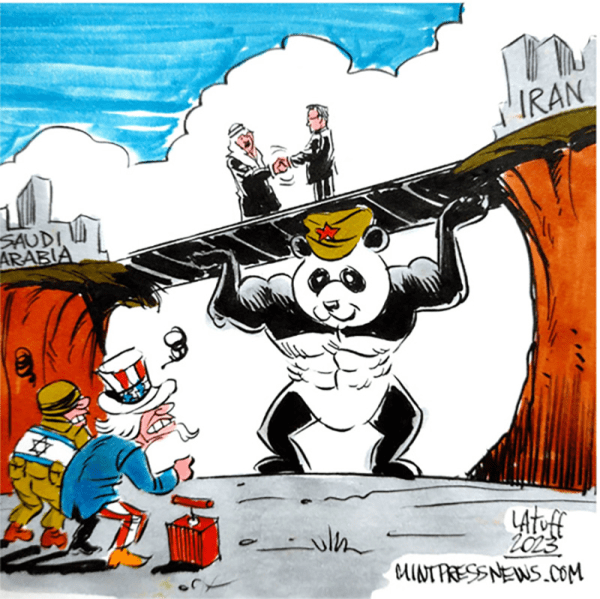
Wang Yi of the Communist Party of China, Ali Shamkhani, of Iran, Saudi Arabia’s Musaad bin Mohammed Al Aiban pose in Beijing, China, 10 March 2023 (AFP) 2.jpg

__________________________________

(continued from Part Two)

__________________________________

You can see the degree of panic in Washington concerning these developments in the region. The day this rapproachment was announced Netanyahu called leader of the (United Arab) Emirates asking for an urgent meeting asking for a normalization of the Israeli-UAE relationship as it exists under the Abrahamic Accords agreement that was finalized during the Trump Administration days. They (the Israelis) are worried as a consequence (of the Iranian-Saudi rapproachment).

The Saudis are moving towards a more autonomous relationship from the United States. There is nothing that the United States can do about it apart from resenting these developments. The decision of OPEC Plus (OPEC+) to reduce world oil production (in response to a slowing of the world economy) to maintain price stability is going to affect the United States.

Ibrahim Kazerooni

Israel is in a tizzy over this and really doesn’t know how to handle these developments. Tel Aviv is particularly concerned that one of the consequences of this (Iranian-Saudi) deal has been diplomatic moves to resolve regional conflicts in both Yemen and Syria. At least we’re seeing the beginning of diplomatic moves in this direction, a direct result of the Chinese brokered Iranian-Saudi rapproachment. The last thing that Israel would like to see is a resolution of the Syrian crisis and the rebuilding of that war-torn nation. Rob Prince

Ibrahim Kazerooni: Rob, can I just interject here as we don’t have much time to finish our analysis. I think we should go back to the point concerning what options are available in light of this changing world for the United States

In the light of the current crisis you indicated that you don’t think that Washington understands what is going on. The Cradle has an article that says that the “U.S. Flexes Its Muscle in the Persian Gulf to No Avail.”

What are the options for the United States in the light of the current crisis?

Rob Prince: In light of the current crisis, what’s necessary for Washington to regain lost influence in the Middle East involves, from where I am sitting, something of a sea change in policy, one that appears the furthest thing from Washington’s current policies. If the United States is going to reduce its dependence on Saudi oil, what is it offering Saudi Arabia in exchange? At this point, it’s really not very much.

Of course there are ways for the United States to compete with China in the region not just for China and Saudi Arabia, but also for the United States. It could help rather than hinder regional economic development; it could help the infrastructural development which has hardly taken place over all these years of U.S.-Saudi “friendship.” The main change needed is that Washington needs a different overall approach to the politics in the region.

The essence of the U.S. approach is “divide and conquer” – as you mentioned earlier, Ibrahim, Ibrahim, partition. Look at the way the region has been partitioned going back to the Sykes Picot Agreement – the original modern partition – and including the fate of Libya, Iraq, what Washington tried to do – and is still trying to do – in Syria, either de facto or de jure partition. This has to be the end of that approach. Partition, regime change – ultimately even if they succeed in the short term, they are not in the benefit of the United States in the long run as they sow discontent and chaos throughout the region. These policies certainly do not benefit the region.

What is needed is a non-hegemonic vision. It’s hard to imagine that the current administration has any interest in moving in that direction. The world has changed; the United States definitely could play a positive role in these changes, but it has to change too. There are no signs in Washington that these changes are taking place.

Ibrahim, what do you think of that?

Ibrahim Kazerooni: Rob I tend to agree with you as well as sharing the views of the above mentioned article in “The Cradle” stating the same thing, that Washington’s options (in the Middle East) in light of the events transpiring there are really limited. There is nothing that the United States can do unless it changes course. We need to deconstruct the U.S.’s response to what is unfolding in the region into various components.

First of all, the Saudi-Iranian detente, so to speak, and the joint statement that has been made public both in China and individually from both in Riyadh and Teheran, the invitation from the Saudi king to the Iranian president and the invitation from the Iranian president to King Salman to visit Iran … on the one hand it shows that Saudi Arabia intends to consolidate this detente, this relationship, because it is beneficial; it can do much to help its modernization plans.

You can see the degree of panic in Washington concerning these developments in the region. The day this rapproachment was announced Netanyahu called leader of the (United Arab) Emirates asking for an urgent meeting asking for a normalization of the Israeli-UAE relationship as it exists under the Abrahamic Accords agreement that was finalized during the Trump Administration days. They (the Israelis) are worried as a consequence (of the Iranian-Saudi rapproachment).

The Saudis are moving towards a more autonomous relationship from the United States. There is nothing that the United States can do about it apart from resenting these developments. The decision of OPEC Plus (OPEC+) to reduce world oil production (in response to a slowing of the world economy) to maintain price stability is going to affect the United States. Read more…

Today – Anniversary of Mussolini’s Execution – Italian Fascism, “Kinder and Gentler” than the Nazi Version? Ask an Ethiopian!

April 28, 2023
tags:

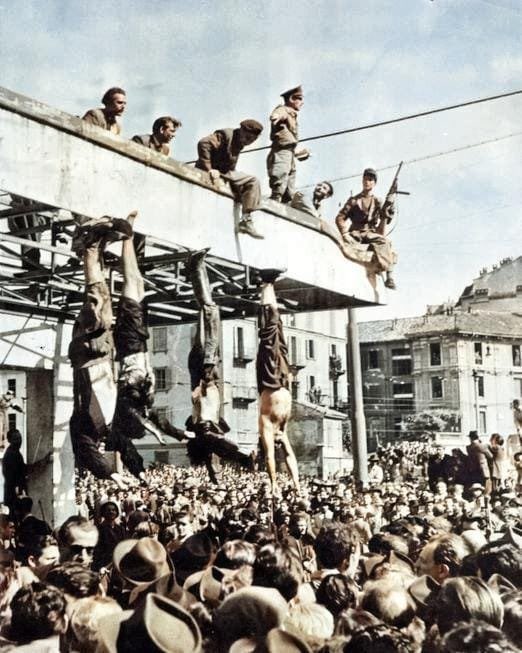
Mussolini and associates hung upside down after being executed. April 28, 1945

On this day in 1945, April 28, 1945:

After Italy’s fascist dictator Benito Mussolini had try to flee to the Swiss border, communist partisans captured him, his mistress and other fascist officials. Walter Audisio, known as Colonel Valerio, executed Mussolini. The others were also executed and the bodies were brought to Piazza Loreto in Milan, where Italians who had suffered under Mussolini’s fascist rule began to beat the corpses. The bodies of Mussolini, his mistress and other fascist officials were hung up on the metal framework of an unfinished Standard Oil petrol station for all to see. (Thank you “Going Underground” for posting elsewhere) 

In the same way as there is something of a Hitler revival among extreme right-wing yahoos here in the USA, a literal Nazi renaissance in Ukraine (underplayed by the Biden Administration and the mainstream media), and elsewhere, there have also been voices trying to sanitize Italian fascism as somehow being “kinder and gentler” than its German Nazi form. But that is little more than putting makeup on a corpse … as the saying goes.

Besides … just ask an Ethiopian for a quite different – and more accurate – impression of Mussolini and his ilk.

Iranian-Saudi Reconciliation: New BFFs? What’s The Deal? Why Are They Suddenly “Making Nice”? Consequences? KGNU – Hemispheres, Middle East Dialogues for April 25, 2023. Hosted by Jim Nelson. Transcript Part Two

April 27, 2023

___________________________

Part One

___________________________

Part Two:

So now we are beginning to see a completely different Middle East being shaped … What is happening in the Middle East is really a major shift … Why are the Saudi’s trying to establish new relations with its former regional adversaries? It is primarily because they have extensive – actually huge plans – for their own economic and infra-structural needs. The Saudi leadership (MBS) has plans for a quantum leap forward economically and socially and turning their country into a major center for economic, social development as well as to become a regional center for the entertainment industry

Ibrahim Kazerooni

Andrew Bacevich says that the U.S. needs to recognize that it might have a “Suez moment” (meaning as a result of the 1956 tripartite UK, France, Israel invasion of Egypt) in which it (Washington) comes to the understanding that the conflict over the control of the Suez Canal – which Egypt (with Eisenhower’s help) won, that this marked the beginning of Britain’s decline as a global hegemonic power and its retreat from international politics in any major way. Afghanistan, Iraq, – failures the world round – might have led the U.S. to realize that force really isn’t the way to go but that diplomacy, post WWII, is the way to look at the world.

Jim Nelson

Ibrahim Kazerooni: Now it turns out that, despite their religious differences, that Iran and Saudi Arabia can find common ground and work together based on common interests. The interests in common that they have include infra-structural development, trade expansion, in the case of the Iranians, the need for increased investment. The Saudis have made it clear that these opportunities can only be achieved in an environment of regional stability.

Naturally what we have as a consequence of this rapproachment between Saudi Arabia and Iran – the possibility of resolving what are called the “peripheral disputes” now exists – such as is the case in Yemen, in Syria, in Lebanon, the issue with Hamas and a few others. There was an article by Scott Ritter in Consortium News, “Syria Comes In From The Cold.” The beginning of that article said that “while the world continues with the reality and consequence of the Chinese brokered rapproachment between Saudi Arabia and Iran, another diplomatic coup is unfolding in the Middle East, one orchestrated by Russia which is the Saudi foreign minister’s visit to Syria.” Saudi-Syrian relations were broken in 2012. Now the Saudi foreign minister’s visit to Damascus will be followed by the Syrian foreign minister’s visit to Riyadh.

So now we are beginning to see a completely different Middle East being shaped. Read more…

Iranian-Saudi Reconciliation: New BFFs? What’s The Deal? Why Are They Suddenly “Making Nice”? Consequences? KGNU – Hemispheres, Middle East Dialogues for April 25, 2023. Hosted by Jim Nelson. Transcript Part One

April 26, 2023

____________________________

It turns out that, despite their religious differences, that Iran and Saudi Arabia can find common ground and work together based on common interests. The interests in common that they have include infra-structural development, trade expansion, in the case of the Iranians, the need for increased investment. The Saudis have made it clear that these opportunities can only be achieved in an environment of regional stability.

Ibrahim Kazerooni

____________________________

Jim Nelson: Well, good evening and thanks for tuning in to this edition of Hemispheres on Tuesday April 25 at 2023. I’m your host Jim Nelson. Thanks for tuning in to our listener supported radio, KGNU Denver, Boulder and Ft. Collins. You can also listen to us on the world wide web at http://www.kgnu.org.

This evening on Hemispheres we continue with the Middle East Dialogues. As always our regular panelists are Ibrahim Kazerooni and Rob Prince. Ibrahim Kazerooni is a regular contributor to our International Press Roundtable. Ibrahim has a PhD from the Joint Iliff-University of Denver PhD program. His focus was Religion and Social Change. Rob Prince is also on the line. Rob is a retired Senior Lecturer of International Studies at the University of Denver’s Korbel School of International Studies. He’s published in online magazines such as Foreign Policy in Focus, Algeria Watch and the award-winning Tunisian site Nawaat.com/

Rob, welcome back…

Tonight we’ll be discussing what could be one of the biggest news stories of 2023, the diplomatic reconciliation between Iran and Saudi Arabia ending seven years with no diplomatic relations between the two countries. The rest of the cable news media seems to be fixated on the firing of Tucker Carlson from Fox News is nowhere to be found.

Such an important breakthrough – the easing of two major players in the Middle East certainly rivals – and maybe surpasses – the Iran Nuclear Deal (Joint Comprehensive Plan of Action) – in its importance for the region despite Washington’s silence on the matter. And that is where we’re going to begin, talking about this important agreement.

Rob, why don’t you begin.

Rob Prince: Your introduction was well done Jim because this agreement, this “making nice” agreement between Iran and Saudi Arabia is quite unique and significant.

The current moment suggests something of an epochal struggle consequential for the remaking of the World Order. Decades happening in only four weeks imply precious time needed to put it all in perspective. It’s all happening so fast it’s difficult to put into perspective. To quote Chinese President, Xi Jinping, “changes that haven’t been seen in 100 years” do have a knack of affecting us all in more ways than one. This global power shift can be seen in the startling flow of events in the Middle East and the Horn of Africa.

Ibrahim Kazerooni: To begin with, Rob, I want to underscore what you have just said regarding what is happening in the region.

If we were to contextualized this as just a conflict between China and the United States it would not reflect the depth of the changes that are taking place. Local commentators are referring to the changes as nothing short of a “tectonic shift” in the region (Middle East). Read more…

Iranian-Saudi Reconciliation: New BFFs? What’s The Deal? Why Are They Suddenly “Making Nice”? Consequences? Tuesday, April 25, 2023 @ 6-7 pm Mountain States Time. Streamed live at www.kgnu.org

April 23, 2023

From the AP on April 6, 2023:

“Long-time Mideast rivals Iran and Saudi Arabia took another significant step toward reconciliation Thursday, formally restoring diplomatic ties after a seven-year rift, affirming the need for regional stability and agreeing to pursue economic cooperation.”

How did it happen? What are its consequences? How has it already started to change the region? Role of China? U.S. response to all this.

All that and more! 

KGNU – Hemispheres – Middle East Dialogues Produced by Jim Nelson, with Ibrahim Kazerooni and Rob Prince.

Tuesday, April 25, 2023 @ 6-7 pm Mountain States Time. Streamed live at http://www.kgnu.org

University of Denver Gives In To Pressure from Israeli, pro-Likud Colorado Elements.

April 21, 2023

Nader Hashemi – Director, Center for Middle East Studies, University of Denver

___________________________________________

___________________________________________

I would ask you to listen to the whole video to see how shabbily a major university supports one of its star professors.

This audio file is an hour program with Dr. Nader Hashemi and myself (Rob Prince) concerning the personal attack on Dr. Hashemi started by the Jerusalem Post – and then picked up by media in the United States (CNN) and Colorado essentially calling for his firing as an anti-Semite for an obscure podcast he did with an Iranian website, interestingly enough, one that is critical of the policies of the current government in Teheran. A statement signed by six leaders of Denver’s Jewish Community called on the University of Denver to fire him.

In this interview produced by KGNU’s Joel Edelstein, Dr. Hashemi rejects the charges and responds to the accusations. Disappointing was the University of Denver’s statement essentially “throwing Hashemi under the bus.” A number of issues come to the fore in this case – that of academic freedom for a tenured professor, the failure of a university administration to defend one its more prominent faculty members, the ongoing attack on professors and Middle East centers that fail to “tow the line” to the pro-Zionist mainstream narrative.

The Center for Middle East Studies at the University of Denver’s Korbel School of International Relations was founded twelve years ago. It’s academic integrity and that of its director, Dr. Hashemi, are well known. The University of Denver which prides itself on “celebrating diversity” has just given in to outside pressure to make Hashemi’s stay at the University of Denver untenable. One of the goals of the campaign of slander against Hashemi is to dissolve the Center for Middle East Studies whose future is in doubt.

In this audio, Hashemi explains his ordeal. Invited to participate along with Hashemi because I taught at D.U. for 23 years and was involved in the initial birth of the Center for Middle East Studies prior to my retirement. (RJP).

Guest Blogger: Girma Berhanu: Ethiopia’s growing fragility and instability: A Looming Geopolitical Disaster In The Horn Of Africa

April 19, 2023

Ethiopian coffee ceremony

(This article, reposted here, first appeared in the Eurasia Review)

Ethiopia’s growing fragility and instability

by Girma Berhanu

Having won the Cold War globally, the US-led West midwifed the birth of a new post-Dergue Political Order in Ethiopia in 1991.


The new political order was dominated by the Tigre People’s Liberation Front (TPLF) -led so-called Ethiopian People’s Revolutionary Democratic Front (EPRDF), an amalgam of ethnic fronts cobbled together from captured soldiers of the overthrown Army of the Dergue government and a small splinter leftist organization, remnant of the EPRP. The TPLF has always been and remains a secessionist ethnic Tigrayan rebel army ever since its foundation by left-wing students in the 1970s.

The US and the West portrayed the new post-Dergue Political Order as a panacea to Ethiopia’s persistent economic and governance problems. In a similar vein, the proponents of the New Political Order, Meles Zenawi and Issyas Afeworki, comrades-in-arms who succeeded in ousting the Derg and seceding Eritrea, were praised as the new crop of “Visionary Leaders” post-Cold War Africa was witnessing.  TPLF ruled the entirety of Ethiopia for nearly three decades without ever dropping the “liberation” agenda as indicated in its acronym!

The new post-Dergue Political Order was unique in many ways. It was a strange system not only by Ethiopian but even by African standards. For example, contrary to the trend in the rest of Africa where political mobilization based on race, religion, ethnicity, or such primary identities were frowned upon, if not constitutionally proscribed, in Ethiopia, these very divisive attributes were turned around and made foundational blocks of the newly constitution yielding the ethnic “federal system”.

The results of this experiment are there for all to see – three decades down!

Ethiopia witnessed a senseless brutal war with Eritrea in 1997 in which over 100,000 young recruits perished in a brief WW-I style brutal trench warfare. No one, including the West, insisted on holding the TPLF/EPRDF leaders accountable for the loss of lives and eviction of thousands of people and untold human suffering, not to speak of development forgone. With the world uninterested to ask any questions of accountability about the callous irresponsible behavior of the TPLF, and the brutal suppression of the Ethiopian population, the TPLF-led EPRDF regime continued ruling with an iron fist as if nothing happened. As we see below, this behavior of TPLF was encouraged and would recur.

Eventually, in a wave of popular unrest, the TPLF/EPRDF was dislodged from power in 2018. Recalcitrant TPLF retreated to Tigray and launched a series of attacks on the central government which led to the death of over a million young people, war crimes and atrocities, and the displacement of hundreds of thousands of people. TPLF lost the war, at last, and was soundly defeated.

Yet the TPLF was rescued from political and military oblivion, thanks to the US-West instigated [AU-brokered] Pretoria Agreements of 2023, remaining a military threat in the region.

Read more…

Medea Benjamin Tours Colorado Front Range – Calls for Negotiations to end the Ukraine War.

April 19, 2023

Yalta peace table where the structure of the post WW2 world was negotiated. Do we need a “Yalta II” today? I think so (R. Prince photo – Summer, 1986)

_________________________________________________

1.

Although it is unlikely to come to fruition in the near beyond, Code Pink’s Medea Benjamin call for a negotiated settlement to the Ukraine war, is spot on.

Her recent Colorado visit (April 2-4) gave a boost for building a peace movement in the United States that could do what needs to be done: pressure Washington to get serious about sitting down with the Russians (including other relevant parties) to end the bloodshed in Ukraine before it escalates into something far more widespread and dangerous. Kudos for the Rocky Mountain Peace and Justice’s Global Peace Collective for organizing and spearheading the visit.

Not that negotiations to end the Ukraine war are in the offing. They are not. Neither Russia nor U.S./NATO are in a negotiating mood at the moment. Washington wants what is essentially its NATO proxy war against Russia to continue with the goal, one way or another, to weaken Russia. On the other hard, Russia will continue its Special Military Operation in Ukraine until the country is de-nazified, its Russian-speaking people’s rights insured and Ukraine accepts status as a neutral, non-NATO state. Neither Crimea nor the territories taken (or liberated) from Ukraine in the Donbass.Trust between the political leadership of all the main players (US, UK, NATO, Russia, Ukraine) is at an all-time low.

Can the situation in Ukraine deteriorate any further? I keep thinking no, and then as Malvina Reynolds noted “Well you think you’ve hit bottom, oh no! There’s a bottom below! There’s a low below the low you know. You cannot imagine how far you can go

Of course, calling for negotiations now might seem like “pissing in the wind” – something of which my father often accused me as my politics moved left in my early twenties.  No doubt a vastly changed – and improved – political environment is necessary to get to that point. The kind of confidence building measures that usually proceed formal negotiations are non-existent as are contacts between Washington and Moscow, a dangerous situation in and of itself. Past efforts both prior to and since the beginning of Russia’s Special Military Operation in Ukraine have gone nowhere. The framework for resolving the conflict taking into consideration Ukraine’s sovereignty and Russia’s security concerns exists but also has gone nowhere. While Western governments (and mainstream media) have shown themselves to be insincere negotiating partners. The Minsk Accords (2014, 2015) were used by NATO to buy time to rearm and rebuild the Ukrainian military to NATO standards rather than forming the basis of a negotiated settlement. Russian concerns about their own security interests and NATO expansion into Eastern Europe were equally brushed aside. Washington/London/NATO sabotaged the Istanbul talks of late March, early April 2022 when it appeared that the Kiev Government, trying to limit its losses, was open to some settlement. More recently, Washington’s refusal to even consider  Chinese broad-based framework to end the war was rejected within 24 hours of its being announced. Instead both U.S. Secretary of State Blinken and Defense Secretary Austin’s belligerent comments – U.S. goal to weaken Russia – only throw yet another monkey wrench into the works making negotiations that much more remote.

Read more…

Guess Bloggers: Medea Benjamin and Nicolas J.S. Davies: Finland’s NATO Move Leaves Others to Carry On the ‘Helsinki Spirit’

April 18, 2023
tags:

Pitka Koski (outside Helsinki – July, 2011)

(This article originally appeared in The Progressive on April 17, 2023. As someone who had the good fortune – along with our entire family – to live and work in Finland for five years “back in the day”, I was genuinely surprised to watch Finland’s stampede into NATO. We lived in Finland (Louhala, Kaivoksela in Vantaa just outside of Helsinki) in the second half of the 1980s and were deeply impressed with Finland’s neutrality – it’s ability to have good relations both with the Soviet Union, with which it shared an 800 mile border [now the Russian-Finnish frontier] on the one hand, and Western Europe and North America on the other hand. I was aware of Finland’s lurching rightward economically (joining the EU, whittling down its extensive social contract some) over the decades since the collapse of Communism but was under the illusion that Finland would continue to play a moderating and balancing role between NATO and post-Communist Russia. All that is gone with the fast changing geopolitics which has swept away Finnish neutrality. To my mind there is more to the Finnish political shift than in this article – which concentrates on NATO’s successful courting of the Finnish military and its political class – but still this is an important contribution to the “Finnish Shift” which I fear will be long standing. RJP)


Finland’s NATO Move Leaves Others to Carry On the ‘Helsinki Spirit’

The country has abandoned its longtime neutrality for the sake of its military-industrial complex.

BY 

APRIL 17, 2023

On April 4, Finland officially became the thirty-first member of the NATO military alliance. The 830-mile border between Finland and Russia is now by far the longest border between any NATO country and Russia, which otherwise borders only Norway, Latvia, Estonia, and short stretches of Poland and Lithuania.

In the context of the not-so-cold war between the United States, NATO, and Russia, any of these borders is a potentially dangerous flashpoint that could trigger a new crisis. But a key difference with the Finnish border is that it comes within about 100 miles of Severomorsk, where Russia’s Northern Fleet and thirteen of its twenty-three nuclear-armed submarines are based. This could well be where World War III will begin, if it has not already started in Ukraine.

In Europe today, only Switzerland, Austria, Ireland, and a handful of other small countries remain outside NATO. For seventy-five years, Finland was a model of successful neutrality, but it is far from demilitarized. Like Switzerland, it has a large military, and young Finns are required to perform at least six months of military training after they turn eighteen-years-old. Its active and reserve military forces make up over 4 percent of the population—compared with only 0.6 percent in the United States—and 83 percent of Finns say they would take part in armed resistance if Finland were invaded.

Yet only 20 to 30 percent of Finns have historically supported joining NATO, while the majority have consistently and proudly supported its policy of neutrality. In late 2021, a Finnish opinion poll measured popular support for NATO membership at 26 percent. But after the Russian invasion of Ukraine in February 2022, that figure jumped to 60 percent within weeks and, by November 2022, 78 percent of Finns said they supported joining the alliance.

Yet only 20 to 30 percent of Finns have historically supported joining NATO, while the majority have consistently and proudly supported its policy of neutrality. In late 2021, a Finnish opinion poll measured popular support for NATO membership at 26 percent. But after the Russian invasion of Ukraine in February 2022, that figure jumped to 60 percent within weeks and, by November 2022, 78 percent of Finns said they supported joining the alliance.

As in the United States and other NATO countries, Finland’s political leaders have been more pro-NATO than the Finnish public. Despite long-standing popular support for neutrality, Finland joined NATO’s Partnership for Peace program in 1997. Its government sent 200 troops to Afghanistan as part of the U.N.-authorized International Security Assistance Force after the 2001 U.S. invasion, and they remained there after NATO took command of this force in 2003. Finnish troops did not leave Afghanistan until all Western forces withdrew in 2021, after a total of 2,500 Finnish troops and 140 civilian officials had been deployed there, and two Finns had been killed.

A December 2022 review of Finland’s role in Afghanistan by the Finnish Institute of International Affairs found that the Finnish troops “repeatedly engaged in combat as part of the military operation that was now led by NATO, and had become a party in the conflict,” and that Finland’s proclaimed objective, which was “to stabilize and support Afghanistan to enhance international peace and security” was outweighed by “its desire to maintain and strengthen its foreign and security policy relations with the U.S. and other international partners, as well as its effort to deepen its collaboration with NATO.”

As a small new NATO member, Finland will be just as impotent as it was in Afghanistan to affect the momentum of the NATO war machine’s rising conflict with Russia.

In other words, like other small NATO-allied countries, Finland was unable, in the midst of war, to uphold its own priorities and values. As a result of these confused and conflicting priorities, Finnish forces were drawn into the pattern of reflexive escalation and use of overwhelming destructive force that have characterized U.S. military operations in all of its recent wars.

As a small new NATO member, Finland will be just as impotent as it was in Afghanistan to affect the momentum of the NATO war machine’s rising conflict with Russia. Finland will find that its tragic choice will leave it, like Ukraine, dangerously exposed on the front lines of a war directed from Moscow, Washington, and Brussels that it can neither win, nor independently resolve, nor prevent from escalating into World War III.

Finland’s success as a neutral and liberal democratic country during and since the Cold War has created a popular culture that’s more trusting of politicians than people in most Western countries. So the near unanimity of the political class to join NATO in the wake of the Russian invasion of Ukraine faced little public opposition. In May 2022, Finland’s parliament approved joining NATO by an overwhelming 188 votes to eight.

But why have Finland’s political leaders been so keen to “strengthen its foreign and security policy relations with the United States and other international partners,” as the Finland in Afghanistan report said? As an independent, neutral, but strongly armed military nation, Finland already meets the NATO goal of spending 2 percent of its GDP on the military. It also has a substantial arms industry, which builds its own modern warships, artillery, assault rifles, and other weapons.

NATO membership will integrate Finland’s arms industry into NATO’s lucrative arms market, boosting sales of Finnish weapons, while also providing a context to buy more of the latest U.S. and allied weaponry for its own military and to collaborate on joint weapons projects with firms in larger NATO countries. With NATO military budgets increasing, and likely to keep increasing, Finland’s government clearly faces pressures from the arms industry and other interests. In effect, its own small military-industrial complex doesn’t want to be left out.

Since it began its NATO accession, Finland has already committed 10 billion euros to buy American F-35 fighters to replace its three squadrons of F-18s. It has also been taking bids for new missile defense systems, and is reportedly trying to choose between the Indian-Israeli Barak 8 surface-to-air missile system and the  David’s Sling system, built by Israel’s Raphael and the United States’ Raytheon.

NATO membership will integrate Finland’s arms industry into NATO’s lucrative arms market, boosting sales of Finnish weapons.

Finnish law prohibits the country from possessing nuclear weapons or allowing them in the country, unlike the five NATO countries that currently store stockpiles of U.S. nuclear weapons on their soil—Germany, Italy, Belgium, Holland, and Turkey. But Finland submitted its NATO accession documents without the exceptions that Denmark and Norway have insisted upon to allow them to prohibit nuclear weapons. This leaves Finland’s nuclear posture uniquely ambiguous, despite President Sauli Niinistö’s promise that “Finland has no intention of bringing nuclear weapons onto our soil.”

The lack of discussion about the implications of Finland joining an explicitly nuclear military alliance is troubling, and has been attributed to an overly hasty accession process in the context of the war in Ukraine, as well as to Finland’s tradition of unquestioning popular trust in its national government.

Perhaps most regrettable is that Finland’s membership in NATO marks the end of that nation’s admirable tradition as a global peacemaker. Former Finnish President Urho Kekkonen, an architect of the policy of cooperation with the neighboring Soviet Union and a champion of world peace, helped craft the Helsinki Accords, a historic agreement signed in 1975 by the United States, the Soviet Union, Canada, and every European nation (except Albania) to improve détente between the Soviet Union and the West.

Finnish President Martti Ahtisaari continued the peacemaking tradition and was awarded the Nobel Peace Prize in 2008 for his critical efforts to resolve international conflicts from Namibia to Aceh in Indonesia to Kosovo (which was bombed by NATO).

Speaking at the United Nations in September 2021, Finnish President Sauli Niinistö seemed anxious to follow this legacy. “A willingness of adversaries and competitors to engage in dialogue, to build trust, and to seek common denominators—that was the essence of the Helsinki Spirit. It is precisely that kind of a spirit that the entire world, and the United Nations, urgently needs,” he said. “I am convinced that the more we speak about the Helsinki Spirit, the closer we get to rekindling it—and to making it come true.”

Of course, it was Russia’s decision to invade Ukraine that drove Finland to abandon the “Helsinki Spirit” in favor of joining NATO. But if Finland had resisted the pressures on it to rush into NATO membership, it could instead now be joining the “Peace Club” being formed by Brazilian President Luiz Inácio “Lula” da Silva to revive negotiations to end the war in Ukraine. Sadly for Finland and the world, it looks like the Helsinki Spirit will have to move forward without Helsinki.


De-Dollarization Intensifies

April 15, 2023

Although there are other factors involved in the global shift towards de-dollarization, fear of other countries getting sanctioned by the U.S. is accelerating the process.

La dédollarisation en marche

April 11, 2023

The International Community’s increasing efforts to decouple their trade relations from the dollar is following its course and is increasingly reaching the practical stage of things. On the Western, liberal side – the analyzes of the events try to be reassuring, minimizing the damage concerning the future of the American currency as the fundamental international means of exchange. But for the major non-Western powers and the countries of the global South – moving away from the dollar, or at least hedging their bets, the situation is fast moving away from the U.S. based currency.

What might have seemed almost impossible to Western analysts only a few years ago – has indeed taken off, and with confidence. When the international de-dollarization process is observed today, it must certainly be understood that it was completely unexpected, especially given the pace currently observed, neither by Washington nor its main followers in the Western space.

This is hardly surprising. Read more…

Guest Blogger: M. K. BHADRAKUMAR US sees in Finland’s NATO accession encirclement of Russia

April 6, 2023
tags:

Finland – summer of 2011

US sees in Finland’s NATO accession encirclement of Russia

The national flag of Finland was raised for the first time at the headquarters of the North Atlantic Treaty Organisation in Brussels on Tuesday, which also marked the 74th anniversary of the western alliance. It signifies for Finland a historic abandonment of its policy of neutrality. 

Not even propagandistically, anyone can say Finland has encountered a security threat from Russia. This is an act of motiveless malignity toward Russia on the part of the NATO,  which of course invariably carries the imprimatur of the US, while being projected to the world audience as a sovereign choice by Finland against the backdrop of Russia’s intervention in Ukraine. 

Quintessentially, this can only be regarded as yet another move by the US, after the sabotage of the Nord Stream gas pipelines last September, with the deliberate intent to complicate Russia’s relations with Europe and render it intractable for the foreseeable future.

On the other hand, suffice it to say, this will also make Europe’s security landscape landscape even more precarious and make it even more dependent on the US as the provider of security. The general expectation is that Sweden’s accession to NATO will now follow, possibly in time for the alliance’s summit in Vilnius in July. 

In effect, the US has ensured that the core issue behind the standoff between Russia and the West — viz., the expansion of the NATO to Russia’s borders — is a fait accompli no matter the failure of its proxy war in Ukraine against Russia. 

Responding to the development, Kremlin spokesman Dmitry Peskov warned on Tuesday that Finland’s NATO membership will force Russia “to take countermeasures to ensure our own tactical and strategic security,” as Helsinki’s military alignment is an “escalation of the situation” and an “encroachment on Russia’s security.” 

On April 4, the Russian Foreign Ministry stated that Moscow “will be forced to take retaliatory measures of both military-technical and other nature in order to stop threats to our national security.” 

Finland’s NATO membership would extend NATO’s frontline with Russia by 1,300 kilometers (length of border Finland shares with Russia), which will put more pressure on Russia’s northwestern regions. Don’t be surprised if NATO missiles are deployed to Finland at some point, leaving Russia no option but to deploy its nuclear weapons close to the Baltic region and Scandinavia. 

Suffice to say, the military confrontation between NATO and Russia is set to deteriorate further and the possibility of a nuclear conflict is on the rise. It is hard to see Russia failing to preserve its second strike capability at any cost or prevent the US from gaining nuclear superiority, and maintain the global strategic balance.  

The focus will be on the upgrade of defensive nuclear capabilities rather than on conventional forces, compelling Russia to demonstrate its nuclear strength. Russia has already front-loaded its deterrent by deploying tactical nuclear weapons in Belarus in response to the UK’s irresponsible decision to provide depleted uranium munition to Ukraine. It is all but certain that Russia will also double down in the Ukraine conflict. 

Meanwhile, the US has for long deployed tactical nuclear weapons in European countries, including Belgium, Germany, Italy, the Netherlands and Turkey, which means the US has long deployed its tactical nuclear weapons at Russia’s doorstep, posing a significant threat to Russia’s national security. Russia’s deployment in Belarus is aimed at deterring the US’ potential provocations, anticipating what is about to happen. 

Belarus’ geographical location is such that if Russian tactical nuclear weapons are deployed there, it will have a huge strategic deterrent effect on several NATO countries such Poland, Germany, the Baltic states and even the Nordic countries. A vicious cycle is developing, escalating the nuclear arms race and ultimately developing into a doomsday situation that no one wants to see.

The big picture is that knowing fully well that the situation could become extremely dangerous, the US is nonetheless relentlessly piling pressure on Russia with the objective of perpetuating its hegemonic system. Ronald Reagan’s strategy to use extreme pressure tactic to weaken the former Soviet Union and ultimately drag it down, is once again at work. 

In immediate terms, all this would have negative consequences for the conflict in Ukraine. It is plain to see that Washington no longer seeks peace in Ukraine. In the Biden Administration’s strategic calculus, if Russia wins in Ukraine, it means NATO loses, which would permanently damage the US’ transatlantic leadership and global hegemony — simply unthinkable for the Washington establishment. 

Without doubt, the US-NATO move to persuade Finland (and Sweden) to become NATO members also has a dimension in terms of geoeconomics. The alliance’s secretary-general Jens Stoltenberg recently stated, “if Finland and Sweden join the alliance, NATO will have more opportunities to control the situation in the Far North.” He explained that “both of these countries have modern armed forces that are able to operate precisely in the harsh conditions of the Far North.” 

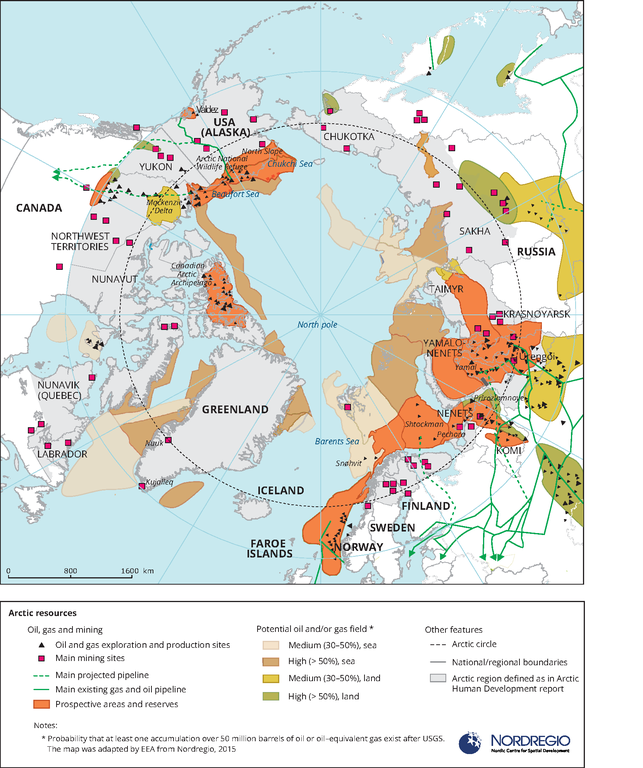
The US hopes that the “expertise” to operate in the Arctic and sub-Arctic conditions that Sweden and Finland can bring into the alliance is invaluable as a potential game changer when a grim struggle is unfolding for the control of the vast mineral resources that lie in the Far North, where Russia has stolen a march so far. 

As polar ice melts at unprecedented speed in the Arctic, the world’s biggest players are eyeing the region as a new “no man’s land” that is up for grabs. Some recent reports have mentioned that moves are afoot for the integration of the air forces of four Nordic countries — Denmark, Norway, Finland and Sweden —  undertaken with an undisguised anti-Russian orientation. 

Arctic Resources

In military terms, Russia is being forced into sustaining the heavy financial burden of a 360 degree appraisal of its national security agenda. Russia has no alliance system supplementing its military resources. In an important announcement in February, paying heed to the straws in the wind, the Kremlin removed from its Arctic policy all mentions of the so-called Arctic Council, stressing the need to prioritise Russian Arctic interests, and striving for greater self-reliance for its Arctic industrial projects. 

The revised Arctic policy calls for the “development of relations with foreign states on a bilateral basis,… taking into account the national interests of the Russian Federation in the Arctic.” This came days after a US state department official stated that cooperation with Russia in the Arctic was now virtually impossible.

Academic Freedom and the Israeli-Palestinian Conflict at the University of Denver

April 6, 2023

What triggered this event was an orchestrated campaign targeting Nader Hashemi, Director of the Center for Middle East Studies at D.U., the latest in a series of attacks on academic freedom at the University of Denver. As usual, Hashemi has been smeared as “anti-semitic” for his support for an overall Middle East process that includes, justice for the Palestinians. If you can make it I believe it will be worth your while….