Sarah Roy is a senior research scholar at Harvard’s Center for Middle Eastern Studies and author of `Failing Peace: Gaza and the Palestinian-Israeli Conflict’. If you google her name you’ll see that a few of her pieces have appeared in `Counterpunch’ and stumble across the fact that among other things, she happens be Jewish (and it seems rather religious). But now she’s made the big time with an op ed in Boulder’s Colorado Daily (Tuesday, July 17) pointed out by Ron Forthofer of Longmont (and also former Green Party candidate both for governor and US Congress). Congratulations Sarah Roy. Actually a number of us were startled to see The Colorado Daily choose to publish this piece. The article is co-authored by Augustus Richard Norton of Boston University.
Entitled `Yes, you can work with Hamas’, it more or less parallels my July 16 entry `When Tragedy Becomes Farce and Then Tragedy Again’ (see below), but is more positive. (I know, I’ll try to work on that).
In one sentence Norton and Roy sum up my thoughts that day `The Bush Administration’s approach to the divided Palestinian territories is inviting disaster’. Agreed.
They then offers three specific concrete steps to correct the present course of the Bush Administration:
1. Announce support for a Hamas-Fateh dialogue to revive a unity government and quietly open diplomatic contacts with Hamas
2. Commit serious diplomatic muscle to restarting substantive Palestinian-Israeli negotiations
3. In cooperation with its Quartet partners – the European Union, Russia and the United Nations – convene a peace conference informed by the US commitment to a two-state solution.
While it is unlikely that the Bush Administration – stone deaf to any humane proposal that might actually end the Occupation and the conflict – will take Roy’s advice, in a few quick brush strokes, she sums up nicely the policy changes needed to turn the mess around. When people ask what can we do? – I’d say that a good starting point would be to argue for these three points. There are some others I would add (end building settlements, dismantle the wall, etc, etc, stop suggesting that somehow Hamas is Al Qaeda’s spiritual twin – which it isn’t) but Roy and Norton’s suggestions would be a fine place to start.
The comments that follow, especially those quoted just below, are worth thinking about
“Meanwhile the defining fact of Palestinian life among Gazans and West Bankers is dispossession and humiliation under the continued Israeli occupation….Despite the dangerous division of the Gaza Strip and West Bank, it is unlikely that Palestinians will cede their desire for a state with East Jerusalem as its capital. Hamas voters overwhelmingly support a two-state solution, and the Hamas leadership has declared it would honor any agreement ratified by popular referendum”.
For the full article http://coloradodaily.com/articles/2007/07/17/opinion/your_take/yourtake2.txt or you can simply click here
Responses to Blog
1. on the Dems and Iraq
from Mark Benner – Progressive Democrats of Colorado
“good points – just a couple of interesting observations about the sad case of democratic leadership failing.
Just over 6 months ago the Republican leadership in the senate regularly complained every time Democrats discussed holding up a Senate action by using the filibuster procedure to block Republican action, that such moves prevented “important” legislation from reaching a up or down vote on the floor of the senate. Democrats helped by Ken Salazar and others caved in and allowed votes on Samuel Alito and the Military commissions Act for example. Now Republicans are using the very thing they advised against to thwart Important legislation from being given an up or down vote.
Maybe democrats will learn – Ken Salazar probably not.
When democrats actually passed legislation that created timetables for the withdrawal of troops from Iraq – Bush vetoed it. Instead of refusing to create another bill and making the case that the president was playing politics with the issue and not supporting the troops – democrats caved in and funded the war, when they should have let it sit there in Bush’s lap.”
Mark Benner
ps. although not very active, I (r.p.) am also a card carrying, dues paying member of Progressive Democrats here in Colorado. for more information on this mutant (because it is progressive) formation within Colorado’s Democratic Party, contact Benner ( mark@pdcolorado.org ) or Vicki Rottman ( vrprods@earthlink.net )
——–
from a friend at Regis University:
“thanks for keeping me on your list for this blog. Not sure I always agree, but I do always find what you say helpful and thoughtful.”
——-
2. On Bush’s New Middle East Peace Initiative Note:
This, below, isn’t a response to the blog, simply on the same subject, response to Bush’s call for a Middle East Conference. I like how Gush Shalom can say in less than 50 words what it takes me 1500 to say) Gush Shalom Ad in Haaretz
Bush’s announcement
About an International “Meeting”,
Without Date, Location and Participants
– It’s just another Soap Bubble. But even if It were serious
– What is the value
Of a meeting
With less than half of The Palestinian people?
972-3-5221732.
Help us pay for Our activities and ads By sending checks to Gush Shalom, P.O.Box 3322 Tel-Aviv 61033. http://www.gush-shalom.org info@gush-shalom.org Ad published in Haaretz July 20, 2007
Bush’s call for Israeli-Palestinian Peace Talks: When Tragedy Becomes Farce (and Then Tragedy Again)
(thanks to Ringo for helping me think this through)
A moment of global shame
As the situation on the ground in Palestine (the West Bank and Gaza) deteriorates and has become so bad that one has to wonder if the Palestinian Authority can ever rebuild a working unity with its constituent elements (meaning Fateh, Hamas, PFLP, DFLP), a number of informal peace proposals are circulating from academia. These seem to be coordinated with a new Bush Administration push to put the Israeli-Palestinian peace making back on the agenda.
When the larger picture is viewed it all looks rather cynical. Again.
The Palestinians are collectively punished with sanctions for having voted for Hamas, rather than what was a generally corrupted Fateh. These sanctions – as harsh as those the US imposed upon Iraq for more than a decade – had the support of the E.U., the U.N and Russia (the so-called Quartet – which has always been in essence a solo operation). Denied food, medicine, access to commercial goods, the right to enter and leave, the Palestinians in Gaza find themselves still under occupation, hermetically sealed in a prison in which they have been pounded repeatedly by Israeli bombing while a disinterested and often hostile world looks on.
There is no proportionality between the home made rockets that fall more often than not harmlessly on Israeli towns bordering Gaza with the unremitting military pounding from air, sea and land that Gazan Palestinians have endured. And while many innocent people have also died in Israel as a result of suicide bombers, these tragedies do not negate the fact that in the West Bank and Gaza Israel has maintained the longest illegal military occupation in modern history with the harsh verdict that implies.
It is a moment – another moment – of great global shame.
Joining the main perpetrators, the United States and Israel – in what amounts to war crimes against the Palestinians – are the European Union and the United Nations, both of which, at best, have played a pathetic role of legitimizing if not encouraging such inhumanity.
They understood what they were doing.
There is little doubt that both the Bush Administration and Israel well understood that the humanitarian crisis that they created in Gaza would sooner or later explode into a military and political crisis as humanitarian conditions worsened. At the same time, brazenly, before the whole world, the United States and Israel financed and armed Fateh – (actually not all of Fateh, only those elements around Abbas). They prodded, provoked and directed the forces around Abbas into a mini Palestinian civil war underestimating Hamas’ strength and base in a manner similar to which both Bush and Olmert underestimated Hezbollah’s position last summer in Lebanon.
It has been particularly disheartening to hear some progressive Jewish people in Colorado blame Hamas as if Hamas had brought all this suffering on itself. For shame.
Divide and Conquer
The `humanitarian squeeze’, a modern sequel to the Nazi siege of Leningrad (bombing from the outside while cutting off the supply of food, medicine and other sustenance) had a political goal, to an extent achieved: to create the conditions in which the Palestinian movement – already long rife with internal divisions – would collapse upon itself.
Having largely accomplished that, the United States and Israel can now gloat that two Palestines exist de facto: one controlled by Hamas in Gaza, the other somewhat (far from entirely) controlled by Abbas’s faction of Fateh on the other. So divided, the Palestinians, whose negotiating position (you know, the old balance of power stuff) has long been deflated for nearly 20 years, since the collapse of Communism and the first Gulf War is weaker still. The prestige and influence of the Palestinian Authority among its own people is almost as low as Bush’s ratings are here in the USA. It has arguably lost its capacity to rule and to unite Palestinians in any negotiating process. And since it can hardly negotiate, solutions will be essentially dictated to it: accept US-Israeli conditions or expect more of the same. A similar divide and conquer strategy is being implemented in Iraq. Iraq might collapse as a nation, but the US mega military bases `enduring’ bases they call them (but not permanent!) are there to stay.
What a coincidence it is that at just such a moment of near total Palestinian weakness that both United States and Israel both think this a fine time to call for negotiations to see what further concessions can be extracted from Abbas!
Ah, but the time is ripe, with the West Bank pock marked with Jewish settlements still expanding daily, with the West Bank cut up into apartheid-like (Jimmy Carter is correct!) Bantustans in which Palestinian life will be even more intolerable in the future than it was in the past! The construction of the wall, symbol of oppression, condemned as illegal by the International Court in the Hague, cuts more deeply into the territory and soul of the West Bank daily.
So it is at this moment, after pulverizing its adversary and assiduously avoiding, rejecting, blocking any semblance of negotiations for 13 years, that Bush and Olmert are making their `peace move’. They are pushed to do so yet again by the Saudis royal family, looking over their own shoulders at all the little Osama Bin Laden’s being born in their feudal kingdom!
The `Peace Now’ Chorus
How interesting that at such a moment there is a chorus of `peace now’ emerging both in Washington and in Tel Aviv! Olmert met with Abbas in Tel Aviv. Why is that when Bush and Olmert finally do talk peace, it makes me want to dive into the nearest bomb shelter? Does it mean: Now that we’ve crushed them politically let’s get together and talk about what crumbs they are to receive, that we can then call a Palestinian state! Bush calls for an international conference to resolve the crisis and Haaretz (July 13, 2007) runs a piece about how the mechanics of peace making might proceed.
The latter was written by one Jerome M. Segal, director of the Peace Consultancy Project at the University of Maryland’s Center for International and Security Studies. The proposal would not have drawn much attention if not for the fact that it was featured in Haaretz and thus must be considered a kind of trial balloon. In this piece Segal claims that if followed, the plan can produce a Palestinian state within a year. Perhaps it can also make hair grow on bold heads. (for the details of the proposal – click here).
It is only when one looks at the context (described above) in which such a proposal is made that one understands – whatever positive aspects it might have – how unrealistic the proposal is. At best it can be considered well intentioned but flakey, `well intentioned’ because it is at least trying to change the momentum from war plans to peace making.
Why then flakey?
Because it is more or less the same brew cooked up once again and claimed to be `new’ or `original’.
1. It is a mini `Camp David’ or `Oslo’ which divides the peace process into stages rather than dealing with final status talks on all issues. Such a framework benefits Israel at the Palestinian expense and is what happened at Camp David (where the Palestinian issue was never even broached) or Oslo where the talks never got behind how to structure the talks. Those talks permitted Israel to talk peace while building settlements. Such a process permits the Israelis to maximize their pressure on an already weakened Palestinian political entity at each stage of the negotiations. Utilizing such a framework issues such as Jerusalem, the Golan Heights or the 48 refugee question are not likely to ever see the light of day..
2. Segal’s proposal basically discards – or certainly doesn’t mention – present other more substantial peace initiatives into which went a considerable amount of thought and political capita (Geneva Accord, Saudi Proposal). The UN is not an initiator or significant participant in the process but brought in at the end as a kind of `tag-along’, to give the process legitimacy. Any process that does not include strong international participation and security guarantees, leaving the key negotiations to the Israelis, the US and a terribly weakened Palestinian authority is not worth much.
3. If read closely, like the processes before, once again, it is the Palestinians that are asked to make all the concessions. There is nothing here that suggests that Israel is an occupying power and that the Palestinian people are an occupied people. Israel is not asked to stop sanctions against Gaza, to stop building the wall, settlements, end check points. It does not in any way challenge Israel’s military control of the Occupied Territories. This is not just a moral issue, but a question of international law as well.
One could go on. All this will not lead to peace but to further instability and war.
Sorry for being such a hard ass…but that’s how I see it.
Boulder Peace Activists Report Back: Friends of Sabeel Trip to Israel and Palestine Report Back
At a meeting in Boulder last week (July 11, 2007), a number of peace activists, returned from Israel and Palestine (W. Bank). They had been on a Friends of Sabeel delegation. They held a public event at the University of Colorado to show slides and discuss their impressions of what they had seen and experienced in the Occupied Territories. They had many interesting first hand observations and insights. It was all very well done. Not surprisingly, there were a number of hostile questions from a number of people who, in turn, taunted the speakers and then, although they sat in different parts of the room, almost in unison, got up and left, grumbling as they left.
The speakers addressed all the questions to the best of their abilities, quite honestly and fairly I thought, except for one. A woman sitting in the back asked one of those questions that was more of a statement than a question but finally got to the point: how can this mess (the Occupation, the Israeli-Palestinian conflict) be resolved? Great question and I waited for the answer. After a certain hesitation and silence, finally one of the speakers, LeRoy Moore of the Rocky Mountain Peace and Justice Center answered clearly and simply: End the Occupation. In the end, those three words are the key to resolving the conflict. Often in the discussions of the Israeli-Palestinian conflict, and in a very purposeful way, the term `Occupation’ is assiduously avoided. Israel’s more zealous supporters, both locally and nationally bristle at its mention.
Occupation – Not `Disputed Territories’
Not long ago two Colorado Democrats in Congress, Diana DeGette and Mark Udall wrote letters to Colorado Democrats asking them not to use the term `occupation’ which they consider inflammatory. But calling a spade a spade: what Israel is doing to the Palestinians in the Occupied Territories (another term they don’t like) is very much an occupation – the longest and one of the cruelest and inhumane occupations by one nation of another in recent times. Now forty years on, it’s lasted longer than the Indonesian occupation of East Timor. So Occupation is quite frankly an accurate and objective term and when peace activists call for ending the occupation, I believe they are hitting the nail right on the head.
That said, the question remains – and this one is still more difficult to broach for some: how can it [ending the occupation] be done. The critique is fine, but without a positive vision – which means proposing a political solution – something is missing. It is all well and good to make a morally and historically accurate critique. But what then? What is the positive alternative that people can support to help resolve the issue politically? And when it gets to proposing political solutions many peace movements and activists find themselves caught in a bind between the different solutions: two states, a binational state (someone did mention that as a possibility that evening) or a democratic secular solitary state for Palestinians and Israelis. Of course, ending the occupation is the pre-requisite for any positive option – 1 state, 2 states, whatever.
My own views on this are well known: I oppose the Occupation and support a 2 state solution (Israel’s right to exist in security within its 1967 borders, a viable Palestinian state in the West Bank and Gaza, and both with a shared capital in Jerusalem) and I would hope to see others more seriously consider this option. Whatever, if the level of activity gravitates only around critiques without progressive, human and practical solutions, I don’t believe that the work on this issue will advance very far in the peace movement or that its influence will grow much.
For more information about a presentation from this group, contact Joy Lapp (lappj@earthlink.net)
“Almost every war is stupid. The last war [in Lebanon] was more stupid than most. The next war, if there be one, will be even stupider”
Note: Avnery’s writings can also be accessed through the `links’ section of this website. Although a `voice in the wilderness’ of an otherwise militarized Israeli society his political experience and wisdom are unmatched (from what I can tell). I found particularly interesting his assessment that the Bush Administration needed the war last year to compensate for its Iraqi debacle. A victory against Hezbollah would have put pressure on Syria and not just strengthened Israeli’s northern flank but given a boost the US war effort in Iraq. In the end, he argues, convincingly, that no one won that war but the biggest losers were the US and Israel. For the full version of the article, simply click on the end of the selection:
A Stupid War by Uri Avnery (July 14, 2007)
A DETECTIVE trying to solve a crime always asks “cui bono?” (who would profit?) When we try to solve the crime called the Second Lebanon War, this question must head the list.
The day before yesterday, a full year after the war, the Israeli media devoted most of their time to the retrospective analysis of the war. Hour after hour of television time, page after page of print.
When the war broke out, all the media rooted for Olmert. Except for a few lone voices, the media performed like a group of prancing cheerleaders at an American football game. The anti-war demonstrations were hidden away. No wonder, therefore, that this week, too, the anti-war protest was completely ignored, and all the criticism in the media came from the right.
Dozens of penetrating questions: Why was the decision taken in haste? Why wasn’t the army ready? Why wasn’t the rear prepared for war? But one issue was not considered: why was there a war at all?
QUESTION NO. 1: Who stood to profit?
In order to understand why the war broke out, the question is not who profited from it in practice. The decisive question is: who would have profited from the enterprise if it had succeeded as planned?
The one who stood to gain the most was the President of the United States. George Bush was already stuck in the Iraqi quagmire. He desperately needed a success in the Middle East.
The Israeli army was to break Hizbullah, a supposed proxy of the Axis of Evil, and allow the pro-American client government of Fouad Siniora to take control of all of Lebanon. Since nobody doubted the huge superiority of the Israeli army over a small band of guerillas, that was to happen within days.
This scenario included a second chapter: the victorious Israeli army was to provoke the Syrian army, and after a short war, the regime of Bashar al-Assad should have collapsed. The Axis of Evil would have been smashed, American public opinion would have been convinced that the “vision” of President Bush had been realized, “Democracy” in the Middle East would have been triumphantly on the march, the Iraq fiasco would have become irrelevant.
The second one to profit would have been Ehud Olmert. The Prime Minister, who by sheer accident had taken over from Ariel Sharon, and who until then had been a bit player, would have been recognized as an outstanding leader, statesman and strategist. Even the trade union hack, whom Olmert had put in charge of the military establishment, would have cashed in.
According to this scenario, the threat to the North of Israel would have been eliminated, the arsenal of rockets would have been destroyed, Hizbullah would have been wiped off the map, an alliance would have been formed between Jerusalem and America’s clients in Beirut. And if Syria, too, had collapsed, an ideal situation would have been achieved. The entire threat to the North of Israel, which had worried the Israeli military strategists for decades – the crescent of Iraq, Syria and Lebanon – would have been neutralized. Olmert would have entered history as the man who had eliminated from the Bible the verse of Jeremiah (1, 14) “Out of the North an evil shall break forth upon all the inhabitants of the land.”
The indirect profiteers would have been the rulers of Egypt, Jordan and perhaps also Saudi Arabia. The Palestinians would have been left even more isolated in their fight than before.
Who pushed whom into the war? Did Bush push Olmert, or did Olmert push Bush? Years may pass before we shall know for sure – and it’s really not so important.
QUESTION NO. 2: Who has profited in practice?
To everybody’s amazement, the Israeli army failed in its task. Hizbullah was not broken, but stood its ground against a military machine that is rated the fifth strongest in the world. The longest war in the annals of Israel since 1949 ended in a draw. So who profited?
Not Israel. True, the Air Force destroyed a large part of Hizbullah’s arsenal of long-range rockets, but the short-range rockets created havoc in the Israeli rear and revealed to the whole Arab world how exposed Israel is to this kind of weapon.
The two captured Israeli soldiers – who had provided the mendacious justification for the war – were not freed. True, an international force has been inserted as a buffer between Israel and Hizbullah, and that was then presented as a huge achievement. But before the war, the Israeli military adamantly opposed the installing of just such a force. The army feared the loss of its freedom of action against Hizbullah. Now the UN force defends Hizbullah against the Israeli army as much as it defends Israel against Hizbullah.
The United States, too, did not profit. According to reports leaked from Washington, the failure of the Israeli army infuriated Bush. He turned his wrath on Olmert. The Israeli military disappointed him. In the course of the war, Bush, with the generous (and loathsome) help of several governments, including Germany, had again and again prevented a cease-fire from coming into force, in order to give Israel a little more time to fulfill the task. It did not help.
Hizbullah also did not gain. True, its steadfast stand against the Israeli army is viewed by many as an act of heroism that restores the dignity of the entire Arab world. Hizbullah’s losses are in the process of being made good. But Hassan Nasrallah, who radiates an extraordinary integrity, found it necessary to admit in public that he would not have carried out the initial incursion into Israeli territory if he had known what would follow. He apologized to the Lebanese public for giving Israel the pretext for the war that caused them so much death and destruction.
Hizbullah is first and foremost a part of the Lebanese scene. The main aim of Nasrallah is to ensure for Hizbullah – and himself – a dominant position in the political system of his country. His alliances with Syria and Iran are a consequence of this objective. The Shiite conspiracy and the terrorist Axis of Evil exist only in the fertile imagination of George W.
The war has not weakened the position of Hizbullah in Lebanon. That was underlined this week when the president of France, Nicholas Sarkozy, invited Hizbullah to take part in an all-Lebanese conference in Paris. But it seems that the war did not strengthen Hizbullah either.
Has Iran gained? After the United States did it a favor and destroyed Iraq, which has served for centuries as a roadblock between Iran and the Arab Middle East, it now has a foothold both in Iraq and Lebanon. But this has its drawbacks, too: the situation is pushing its potential enemies, led by Egypt and Saudi Arabia, into preventive actions.
The conclusion: nobody has gained from this war, from all this death and destruction. By the latest count: in the 34 days of fighting, 119 Israeli soldiers and 39 civilians were killed, and so were 1200 Lebanese civilians and fighters. 2250 Israelis and 4400 Lebanese were injured. 300 thousand Israelis and 1 million Lebanese fled their homes, 200 thousand Lebanese have not yet returned.
QUESTION NO. 3: Has Israel drawn any conclusions?
For a year now, everybody here has been busy with “drawing conclusions”. From the Winograd Commission of Inquiry to the last reporter on TV. E-v-e-r-y-o-n-e.
But this is make-believe. As a result of the conspiracy of silence concerning the basic questions of the war, it is quite impossible to deal with the roots of the problem.
Everybody is dealing, of course, with the rehabilitation of the army. Thank God, everything has changed. Instead of the winged Chief of Staff we now have a commander covered with dust, Gabi Ashkenazi. Every day on TV, we see the brigades training, soldiers crawling among thorns and tanks going through their paces. So the next time (and everybody takes it as self-evident that there will be a next time) the Israeli army will be ready.
Nobody points out the absurdity of this spectacle. The army was not ready for the last war, so it is training now with great determination – for the last war. The conclusions have been drawn from the lack of preparedness for the campaign that was, so everything is now ready for the campaign that was.
If there is anything that can be assumed with certainty about the next war, if there be one, it is that it will not be a repeat of the last. Rockets will play a much bigger role, and will travel much longer distances. The weapons will be more sophisticated. The battlefield will be different.
Much has been said about the inability of the elected government to stand up to the army command in discussion about life and death, starting a war and conducting the campaign. People take comfort in the fact that we now have an “experienced” minister of defense, Ehud Barak, a former army Chief of Staff, prime minister and defense minister. But the change of personalities does not necessarily bring about a change in the balance of powers: in the future, too, a bunch of politicians who happen to be members of the government will not dare to contradict the authoritative and determined view of the military leadership, which always, but always, produces a “professional” intelligence report to support it.
This phenomenon has accompanied Israel since its foundation. A strong leader, like David Ben-Gurion and perhaps Ariel Sharon, can – perhaps, perhaps – somewhat offset this imbalance. But the imbalance remains.
That is now finding its expression in the endless talk about “the next war”, “war this summer”, “a miscalculation that may bring about a war with Syria”, “the inevitable attack on Iran’s nuclear installations”, and so on. It is the army that determines the public discourse. And as the former Chief Rabbi of France lamented this week in Jerusalem: “Peace has become a dirty word in Israel”.
Almost every war is stupid. The last war was more stupid than most. The next war, if there be one, will be even stupider.
The great momentum to build a vast network U.S. military bases in the Middle East is a recent phenomenon. Although US military bases have existed in or near the Middle East for a very long time, it is only within the past 15 years that their number and concentration has grown dramatically, and continues to grow. With the global supply of oil and gas not keeping up with global demand – the tightening of global oil markets – the strategic value of the region – important since oil became the main energy basis for the global economy – soared. The strategic importance of the region soared with it. Beyond the need for oil to run industry and commerce, is the oft forgotten fact that oil remains one of the most profitable sectors of the world economy, both from the sale of oil and gas products, but also, from the financial boom that has resulted from recycling oil profits into the financial sector of the global economy. Put another way, it is not only oil that is profitable, but the money extracted from oil production that fuels a good part of global financial market growth.
While U.S. need for Middle East oil is modest – we import far more from Canada, Mexico and Venezuela than we do from Middle East producers – all predictions are that US oil needs will grow in the decades to come while, at least at present, supplies are stagnating. Control of Middle East oil and gas becomes more essential. Beyond that is the oft missed point that the country/countries that control the Middle East oil flow have a powerful lever over the development of other countries – the Europeans, E. Asia in particular – that is the rest of the core of the global economy to say nothing of the semi periphery and periphery. If one considers oil dependency an addiction, the country/countries that can ration out the drug to the addict has considerable clout. If we can’t compete with the Japanese to make efficient cars, we can hold the oil weapon over their heads all the same.
The security arrangements of dominating Middle East oil production and transport has involved a series of political and security arrangements. The main political arrangement was crafted after the October 1973 War by then Secretary of State (and indicted war criminal) Henry Kissinger. The main outlines of the arrangement have been known for a long time but were described in detail by John Perkins in his now-popular book Confessions of an Economic Hitman. Perkins claims (and I have no reason to doubt him) that he was one of the key people in crafting an arrangement in which the Saudis would keep world oil supplies as stable as possible and would reinvest the profits for oil in construction projects with Western (largely US) firms, buy western military equipment and invest in the Western financial sector. In exchange the US would accept an increase in the price of oil (since most of the increased profits would be recycled anyway back to the west) and, what is not often stated, that the U.S. would refrain from invading Saudi Arabia military – an option which was seriously considered at the time.
Evolution of US Military Presence in the Middle East
The US approach towards constructing military bases in the region has evolved.:
• In the early post war period (1945-1967) the physical military presence was modest. It consisted of important US bases in Turkey, Greece – and until Khadaffi came to power – and Libya combined with attempts to craft military alliances (the Bagdad Pact) and a strong naval presence. When necessary, CIA operations were employed to overthrow unfriendly governments (unfriendly= nationalist governments who would give priority tot their needs for oil use, not the US’s) as in Iran in 1953, a rather scurrilous action which even today the CIA carts out (when targeted by criticism) as example of one of its political successes. Another successful, and often neglected tale of CIA `success’ was its support of an opportunistic and power hungry Iraqi skunk named Saddam Hussein.
• Between 1967-1979, a policy emerged which depended upon two regional powers, Iran and Israel – in conjunction with the already existing US military network and undercover operations. The US was especially impressed with Israel’s dramatic military victory over its Arab nationalist opponents in the June 1967 War, after which began the now famous relationship. Iran played a similar role further east as `policeman of the Gulf’ under the Shah. The combined role was help the U.S. in its effort to `police’ what it feared most: an Arab nationalism independent of US economic and political influence. Among other things, Iran in that period intervened to crush a rebellion in the Dhofar province of Oman. Israel kept its neighbors in check although it suffered what might be considered a minor set back as a result of the October, 1973 War. Both were involved in supporting US efforts elsewhere in the world including considerable Israeli aid to Latin American dictatorships in Guatemala, Argentina, Chile. During this period, the Saudis also played an important role in supporting U.S. regional plans, but it was more of a political and financial role – funding Islamic movements to counter a growing secular left influence, arming conservative forces (which would soon after take on a much larger aspect in Afghanistan) but it was not considered or treated as the kind of security pillar as was Iran and Israel.
• In 1979, with the Iranian Revolution that brought the Ayatollah Khomeini to power the policy of US regional partnership with Israel and Iran was essentially blown to hell. As the Shah’s regime collapsed like a house of cards, the Carter Administration, which neither saw the revolution coming nor knew how to divert it once erupted, panicked. On January 16, 1979, the Shah left Iran permanently and his regime collapsed. Less than 10 months later, on October 1, 1979, President Jimmy Carter announce the formation of what was called The Rapid Deployment Force, a mobile mostly floating US strike force. Although its scope included a global reach, its actual mission was almost entirely focused on the Persian Gulf to replace the US security vacuum created by the Shah’s demise. A few months later, on January 23, 1980, the mission of the Rapid Deployment Force was spelt out in a major policy statement which is now referred to as The Carter Doctrine. The doctrine represented an openly bold face warning: The US would use military force to defend its interests in the Persian Gulf region which were now viewed as deteriorating by the double whammy: the already mentioned Iranian Revolution and in its wake, although only vaguely related, the Soviet invasion of Afghanistan.
• From 1991 (First Gulf War) until today the US strategy shifted once again, this time to an even greater physical military presence throughout the region with the establishment of a string of permanent military bases, some known, others secret. A number of factors were involved in this shift to more permanent regional bases, among them:
1. The collapse of the Soviet Union and the ensuing security vacuum in Central Asia, a region rich in oil and gas at a time when a tightening of energy supplies was already predicted
2. Certain questions concerning Israel’s role in protecting US interests in the region which have more or less erupted into public debate with the Walt-Mearsheimer paper and Jimmy Carter’s book Palestine or Apartheid? But a more fundamental debate over Israel’s value as a security partner in the region began long before with the collapse of the USSR.
3. During the 1990s a number of strategies were tried and then changed. For example in the mid 1990s there was a considerable US military base build up in Saudi Arabia. That build up is one of the reasons, Osama Bin Laden told the world, for the September 11, 2002 attack on the World Trade Center and the Pentagon. Opposition to US bases in Saudi Arabia proved so contentious – and dangerous for the House of Saud, that, despite the enormous expense incurred in building the Saudi bases, they were (mostly) closed with new regional headquarters set up in nearby and seemingly safer (we’ll see) Qatar.
• The events of September 11, 2002 – despite many assertions to the contrary – did not represent any fundamental change in this strategic plan for a U.S. permanent military presence on the ground throughout the region. It simply speeded up a process that had been underway, as I have remarked above, since at least 1979. 9-11 provided the excuse for the Bush Administration to escalate what are essentially bi-partisan plans for a permanent military presence both in Afghanistan and Iraq. In a certain way the events in Afghanistan are a model for Iraq. In both cases not only has the United States failed to put down local insurgencies and restore order necessary for economic development. Besides resulting in untold (and untellable) damage on a human and infra-structural scale, the US military presence has largely aggravated the situations in both places, situations which continue to deteriorate. The US has built in both places the modern version of Crusader fortresses – extraordinary armed cities within all this instability from which they can strike throughout the region at will. Iraq is perhaps going to hell in a hand basket. It matters little, the bases will be built.
Responses to Blog
1.
In Response to `Class Struggle in Northwest Denver’ (July 12 Blog) this from a friend from Peace Corps-Tunisia days living in Stillwater Oklahoma’ on Walmarts and yuppified coffee shops.
a. “All power to the people!! (well, some people, anyway!)
We in Stillwater, population 40,000 at best, are embraced by two Walmarts—one on the east and one on the west.
We do not worry about health food stores. They are hidden in little strip malls at best. And furthermore, we do not worry about yuppified coffee shops. They are few and far between.
We do not even entertain the idea of a Starbucks, let alone a Starbucks on every corner.
We just eat our biscuits and gravy, say our prayers to the only Christian god, throw our plastic garbage in the landfill (the highest point in Payne County) and keep on supporting our Cowboy football team. What else is there to life?
Cheers on a rainy Friday!”
b. There is a possibility that in response to the blog entry, that Joel Edelstein of KGNU will run a story on the Walmart fight in NW Denver.
c. Earl Staelin of Denver writes: Fascinating and uplifting story about beating back another Wal-Mart invasion. I was glad to play a small part in beating back a similar effort in Littleton in a referendum recently. The vote was something 3-1 against Wal-Mart, which even surprised me.
My comment: didn’t know about the Littleton (s. of Denver) effort. Kudos to Earl and the people of Littleton
2. More responses to the review of `Days of Glory’ – this from Marilyn Barden in Sweden (near Stockholm). Marily and Berra are dear friends. Once upon a time, long ago and far away, we were all part of a team. The film reminded Berra of his days in the Swedish army during World War II. [note: the comment below is lifted from the website guestbook where I found it to my surprise – rp]
“I bought the film you recommended “Born Soldier” [must be the Swedish title for `Days of Glory’ which is the English title for `Indigene’ the original French title -rp] was a gem. Berra and I looked at the video version from our TV, Berra from bed, since he is tired every afternoon being 83 years old now and I on the edge of a chair beside him. He experienced the war when he was the age of the fellows in the movie. The difference was that he was in the Swedish calvary and never saw a bullet since Sweden was never officially in the war although the government let German troops travel through Sweden on trains and he saw many German soldiers who deliberately showed their bare rear ends to the Swedish soldiers waiting at the stations as the Germans rushed by in trains on their way to Norway. 1944 was extreamly cold and snow two meters deep so the horses could not move in the snow. Thank you for telling us of this film we will show it to our peace committee friends.
Marilyn
Class Struggles in Northwest Denver
The Sun Flower Market opened a 28,000 ft ² store yesterday on 38 Ave just west of Tennyson in Northwest Denver on the site of the old `Elitch Gardens’ amusement park. The latter had `sold out’ – literally and figuratively – to the mega-amusement park `Six Flags’ company. The park had moved out of the old location to a new one nearer downtown and the Platte River, leaving the old site to those endearing pirannas, local developers. A local institution had bit the dust.
According to an informal survey taken by Nancy and Molly (wife and daughter), Sun Flower Market expected an opening day crowd of 14,000. By 2 pm an employee told them that 12,000 had already shopped there suggesting they would exceed their target. Who knows how many people finally walked through the doors of this `kind-of’ health food store in our neighborhood before the lights were turned out at 10 pm. The next day (today) the place was still packed and I could hardly find a parking space to check the place out.
Who knows how long this love affair will last, but it could very well be permanent . Although few mentioned it, this opening was about more than a new health food store opening, it was about a community coming together and in a very short time mobilizing and defeating one of the biggest companies in the world – Walmart – in its unsuccessful bid to build a beachhead in this part of town.
A notch up from Safeway and the Kroger-owned King Soopers, the Sun Flower Market is a small chain, this being only its 12th store nationally. It is a smaller alternative source of good food than Whole Foods and what appears to soon be its wholly owned subsidiary, Wild Oats. Whole Foods was offered the space but rejected the offer on the grounds that the neighborhood – a largely middle class/working class constituency presently being yuppified – would not bring in enough income to merit the project. Rejected by Whole Foods, as developer Chuck Perry tells the tale, he accepted an offer from Walmart who seemed anxious to build on the same spot.
The prospect of having a Walmart in the neighborhood was both depressing and electrifying. Nancy and I – neither of whom are fans of Walmart because of poor wages and exploitative labor policies in Third World countries, especially China – were less than thrilled to have one near us in the neighborhood where we have lived for more than thirty years. NW Denver is one of the most Democratic-Party areas in the state, with a historic constituency of Irish, Italian and Chicano Catholics and what used to be, along E. Colfax, a center of the Jewish Community (although some of all of these constituencies have moved to the suburbs – the Italians and the Irish to the west and north, the Jews predominantly to the more prosperous southeast).
For all that, it is a relatively quiet neighborhood, not particularly politically active although in the distant past (the 1920s) it was nothing short of a battleground between the predominantly Protestant KKK and an emerging Italian-Irish-Chicano Catholic middle class. Some of the churches on near by Federal Blvd, especially those near the Woodbury Library were nothing less than KKK strongholds and key meeting places. But after Protestant fears subsided (only to find other peoples to fear later), the neighborhood quieted down. True, Jim Fowler and his friends, former Spanish Civil War Lincoln Brigade vets, one of whom could have doubled for Lenin, added a bit of local color, and long deceased Communist Party Chair Roberto Trujillo, lived here along with an active Mafia chapter centered around a local restaurant, Gaetanos (now owned by Denver’s mayor).
And then came Walmart.
Chuck Perry, the local developer, who bought the Elitches site and then developed it, is something of a local figure. I once saw him lobbying the-then new city councilman, Rich Garcia, at the latter’s victory celebration. He was determined to push the Walmart bid through the city council approval process and it appeared that Garcia was amenable to Perry’s pressure. But Garcia, who had defeated a local machine politician to win his seat, had enough doubts about the whole thing to call a constituent meeting to discuss and I believe, push the project through. There are other self-appointed community organizations, people specializing in extracting city funding, often realtor-developer related along with what I can only describe as middle class morality worms ( you know the people who like to turn their neighbors in to the city for minor code violations) that Walmart had worked and gotten support.
So Garcia called a meeting at nearby North High School to which good citizen/developer Perry was invited, along with a representative of the neighborhood muttawa, (committee for the promotion of virtue and the prevention of vice), a Walmart p.r man, to explain to us poor huddled, stoned and heavily lobbied masses why life would be so much better with a Walmart within our midst. Touching.
Nancy and I had to go to the meeting about which I had a sense of impending doom, nothing less. I had prepared a few insipid remarks about how Walmart didn’t need northwest Denver and northwest Denver didn’t need Walmart, did enough statistical research for an in depth 3-5 minute presentation and was trying to decide whether I should just blow my top or appear objective and professorial, if I could even get to the mike. In these crisis situations, truth be told, Nancy sheds all traces of fear and insecurity and becomes a far more formidable foe than myself, a natural born chicken who has to remind himself before the mirror every morning to `show a little courage’ about whatever.
All that changed when we entered the auditorium of North High School.
The room was packed to the gills. Did it seat 800 or a thousand? I don’t know. There were also people standing in the back and along the isles – a packed house. And here I never thought anything other than a Denver Bronco game (the stadium is in our neighborhood) could bring out so many of my neighbors. Virtually every last one of those people in the audience – all 600 or 800 or a thousand of them – were even more upset than Nancy or me; I mean completely and thoroughly pissed. A thing of beauty is a joy forever. This wasn’t a meeting, it was a full scale uprising. It’s like the whole neighborhood had just listened to the theme song of Les Mis `Do you hear the people sing, singing a song of angry men’ and then went on a full scale organizing binge the likes of which I hadn’t never seen.
What followed comes as close to a political wet dream come true as I have had in this mile high city, a town with perhaps the ugliest art museum (from the outside) in the country.
It was a civilized revolt of the masses.. Nobody, as I recall, threw chairs, bottles, beer and if there was an occasional curse, it was less than one would hear at a Rockies game. But one after another, people EVERYONE insisted on having their say: union grocery store workers from nearby Safeway, small shop keepers on Tennyson, people living in the area adjacent to the proposed Walmart site, teacher, single moms, kids – both Chicano and Anglo -, old ladies, ministers, imams, local drug dealers. It was enough to make any Marxist burst into tears of joy!
If Walmart didn’t have such a thoroughly awful labor record, I would have actually felt sorry for its representative. The developer Chuck Perry, did not have a good day. Hardly anyone believed a word he said. Not one to take criticism well, he did not give a particularly convincing showing. As for our new city councilman, Rich Garcia, at the outset of the meeting he supported Walmart’s bid. But he had the good sense to see his political future before him that night, and, being a flexible sort, had a change of heart. His announcement at the end of the meeting, that he would vote against the Walmart proposal might have been the most important sentence of his political career. The audience responded with a rousing cheer.
And then it was over.
Walmart licked its wounds, walked away and proceeded to build two other mega-stores within 5 miles of the old Elitch site, outside the city line though, the revolution subsided and the good people of Northwest Denver went back to their bars, parks and trying to decide what is the best Italian restaurant, who makes the best tamales and tortillas in the neighborhood, and what is the best non-chain coffee shop, the local political class, shaken by this show of mass independence over which they had no control, hesitantly came back to life, the local mutawwa waited a few weeks before snitching on their neighbors about code violations…
But there was still that one shining moment. Neither Walmart nor Northwest Denver will ever forget.
Welcome Sun Flower Market. All power to the people! (Isn’t that what the Black Panthers used to say?)
“The message we’re sending to everyone, not just Iran, is that the United States will have an enduring presence in this part of the world [where else? The Middle East]. We have been here for a long time; we will be here for a long time and everyone need to remember that, both our friends and those who thinking themselves to be our adversaries.”
-Robert Gates, US Secretary of Defense, December 2006
“It’s very clear, our love is here to stay
Not for a year, but forever and a day”
1.
Exchange `love’ for `bases’ and in one word a schmatzy love song gets transformed into a political critique of some relevance. Not bad.
The discussions about the future of the U.S. military occupation of Iraq are heating up. The impression is certainly growing – or being crafted – that the US troops will not be there for long. Republicans are joining their Democratic colleagues in Congress in their criticisms of the policy, the failure of the so-called `surge’ is common knowledge. There are other signs of a shift. For all that, if one watches what the Bush Administration does rather than what it says, all the indications are that the United States has no intention of completely withdrawing from Iraq in the forseeable future. At best what is considered is a kind of tactical withdrawal from urban areas where the US military has proven vulnerable and ineffective. The hundred or so US military bases are being consolidated in to some smaller number (not yet clear how many). They are not referred to as `permanent’ but `enduring’ bases. Chances are they will still be in Iraq for some time.
Much of what we are seeing in Congress and the media is something different: attempting to respond to public opinion, to give the impression of preparations of withdrawal, while exploring the ways to prepare the people of this country (and the world) for somewhat reduced, but still permanent and indefinite US military presence in Iraq. Such a plan appears to have bi-partison support in Congress with a few notable exception (Kucinich for one). It follows a script not unlike that acted out by the British in Iraq in the 1920s when they too were forced to largely withdraw from urban areas to the security of their megabases.
2.
No doubt public opinion has shifted dramatically since the US occupation of Iraq began in March of 2003. Then, the Bush Administration was able to market the lies that Iraq had weapons of mass destruction and to link Saddam Hussein with Al Qaeda and Osama Bin Laden in the public mind. Since then at least 660,000 Iraqis have died, perhaps double the number, the country remains largely in shambles, scandals of torture, rampant US violations of human rights and international law, the death of 4000 US troops (probably alot more as those who die of their wounds are not counted), the expansion of all kinds of secret operations in Iraq and beyond have become common place. The cost of the war – known costs because 40% of the military budget is secret – is now close to half a trillion dollars and mounting. In no war have US veterans been treated more shabbily – as little more than cannon fodder for Halliburton, military industries and the plans of neo-cons obsessed about the US dominating the world in the aftermath of the collapse of the USSR.
This is the tip of the ice berg and one could go on and on to list the human and financial costs of what has already shaped up to be the greatest debacle in US foreign policy history, with implications already more profound than even those of the US loss (read that word again: loss) in Vietnam three decades ago.
As the war has proceeded, domestic oppostion at first quite modest, has continued to swell. Four years on, polls tell us that 77% of the American people are opposed to the US war in Iraq and Bush’s popularity couldn’t get much lower. The distrust, disgust continues to grow. Many believing that the Bush Administration is capable of anything, believe that one way or another, Bush himself was responsible in some way for Sept 11. According to a poll I read this morning on the internet, almost 45% of the people of this country, Democrats, Republicans and Independence support indicting both Bush and Cheney. The media both local and national which cheered the war on in 2003 – indeed and should be indicted for war crimes as much as Bush, Cheney and Rumsfeldt – now, responding to the shifte in public opinion – does cautious exposes and embarrassing investigative stories with some regularity.
The `enduring presence’ of the US military in the Middle East has created `an enduring opposition’, one that has been factored into the Bush Administration’s plans as being more of an annoyance than a serious challenge to all these plans. Of course if the movement does become more effective, broader, there are all kinds of plans to snuff it out a la COINTELPRO programs of the 1970s and with enough legal structure to do so thanks to the Patriot Act. For the moment, anti-war demonstrations remain not particularly large and few of that 77% who oppose the war are actively opposing it, even fewer taking to the streets. True, `the people’ are behind us (the anti-war movement), but sometimes so far behind us that they can only be seen with high powered binoculars. And we wonder if it is the lack of a draft, living in a hyper consumer society, the American fixation of sports, `movement fatigue’ , boredom with movement tactics or some combination there of which has led to the strange lull in activism. A nation of people stoned, most without every having smoked a joint. Virtually any time I sit with serious peace organizers, some variation on this theme emerges. I don’t know the answers. Perhaps it is that we’re just living in different times, the 60s had a very different social/political chemistry than today.
Whatever., let’s not sell ourselves short. This isn’t the first time that the powers that be, the media would like peace activists to believe that our efforts are for naught – just `feel good’ shit of guilt ridden, do gooders, as irrelevant as we are harmless. That has been a constant life long theme many of us have heard: you don’t count, your voice means nothing and furthermore you can’t organize for shit anyhow. The problem is that the famous `they’ repeat that mantra too often, suggesting that they themselves don’t believe and that they are, frankly, like Nixon was, scared.
One indication that the past four years was not a complete waste of time was the results of the elections last November. While the growing distaste for the war itself was probably the primary factor in swaying people, the anti-war movement, doing what it could, as it could to keep the issue in the public conscience, was a key contributing factor to the changed national mood and the electoin result. It was seen as a mandate on Bush’s policy on Iraq – and the resounding defeat suffered by Republicans – was almost universally interpreted as a turning point in public opinion on the war. The message was quite simple, wasn’t it: Get out, the sooner the better. That the ruling class is as stupid as some of us think is seen in the fact that before the election, the powers that be put together a bi-partisan, high level task force, the so-called Baker-Hamilton report whose main themes were outlined even before the votes were counted. It suggested a change of direction. Rumsfeldt’s precipitous departure just after the election back to Taos where he compensates for destroying Iraq with heavy contributions to the local pueblo also suggested that change was in the air. Gates and Rice seemed to be moving in the direction of a different policy, even if at a snails pace.
Some thinker that I read rather carefully (Wallerstein for instance), suggest given the scope of the mess and tragedy in Iraq that US troops will be out of Iraq in a year or two (or in the near future) and that the war in Iraq has reached a turning point. I hope that they are right, but fear they are not. For starters, most of the Democrats themselves have put the breaks on any quick Iraq withdrawal. Nancy Pelosi’s pre-emptive strike to neutralize the impeachment movement (which is still growing) took a valuable tool away from the peace movement. The discussions on time lines, a political maelstrom which trivialized the issue, which resulted in nothing, combined with the eventual vote to give Bush a free hand to use more than $100 billion in additional funding with no strings, suggested that the staying power of the neo-cons, the Bush Administration (and pro-militarist lobbies like AIPAC) is greater than thought.
A closer scrutiny of the Administration’s position suggests that, the fact of the matter is, that the United States is not about to leave Iraq. Yes the role might change some (a tactical withdrawal from most of the cities), but withdrawal is not in the cards. Instead, Iraq is being molded to be the military epi-center of a network of US military bases that spans the whole region. Enormous amounts of money, great construction efforts, the building of what Chalmers Johnson has referred as `medium sized American cities’ are being crafted by a military whose intentions and projects are known not only by the American people, but also by Congress.
What I hope to look at in the blogs that follow is how this policy has evolved over the past 30 years (It was intensified after Sept. 11, 2001 but began long before that), and the shape it appears to be taking. So…tune in.
Response to Blog/Events discussed
1. A few responses to review of `Days of Glory’ (July 8th blog entry) are included below. When I put out the list of what I thought great anti-war films about war, I got a number of others that were recommended (none of which I have seen). Among them:
• Dan Cetinich (Bay Area) wrote that I should see `Army of Shadows’
• Aurelia Mane Estrada (Barcelona) suggested `Paths of Glory’ with Kirk Douglas
• Michael Dover (Michigan but soon Cleveland) suggested `La Vie En Rose’ (biography of Edith Piaf)
Comment from friend in Boulder: `I saw this film in Europe, a heart wrenching and beautiful film. It also reminded me in some way of the Japanese Americans fighting in World War II.
2. Notes (and phone calls) about Jack Galvin (July 7th blog entry). Jack died Tuesday morning at 3 am in Burlington Vt, surrounded people who loved him dearly
“Upon reading your review of Jack Galvin’s life (a very theological piece I thought, without the word used of course) I wondered –
Why aren’t we sitting in the legislature or the Governor’s office – tons of us-. Why is a critical mass so hard to generate while our neo-Nazis rage about the planet? Get a hundred people I am there! On the same day and the same time a hundred each in Salazar’s and Allard’s office. And it be fifty in all seven Congressional offices. And could each of the hundreds have a hundred signatures who support them? I guess fat chance.”
– Bob Kinsey (probable candidate for US Congress in Colorado, Green Party in 2008)
“He lived a fine, ethnical, committed and caring life”
– Eileen Coppola (Houston)
“It’s taken me too long to respond to your email about Jack. Your tribute to him was both quite moving and a faithful representation of a brother in arms whom I remember with great fondness. And, thanks for your kind words about me – the issues of race and racism are etched more deeply in my soul than any other. I often reflect on the halcyon days of our youth and the profound debt I owe to, most especially, you and John, but also to Jack, Margie, Bob, Tony, Roy, my students at Manual High, and so many others. Though my years in Baltimore, New Haven, and most recently in Aroostook County were and are very important to me, my Denver years were, in many respects, the best years of my life.”
– Dick Ayre, Presque Isle Maine
“What a nice piece on your friend Jack. It’s my hope to expose others like him to the world before their time expires on this rock. Thanks for writing it and I’m sorry he’s gone. I guess we have to do our best to cultivate the next Jack though I’m sure nothing will quite replace him.”
– Evan Weissman (actor, Jewish activist for social justice, Denver)
“There will be a service here in Denver in the future…Our dear friend Jack, boy oh boy”
– Pat McCormack (Sisters of Loretto – Denver)
Mr. Prince, Mr. X here. Either the 21st or the 28th there will be ceremony here for Galvin. I don’t know if it’s too irreverent, but I’m thinking we should have a yellow cab procession. (Jack drove a cab for many years in Denver).
Mr. X. (Note: I agree with Mr. X. It would be so cool)

Indigenes (the French title for “Days of Glory”)
Allons enfants de la patrie!
Les jours de gloire sont arrivés!
(Children of the Nation!
The Days of Glory are upon us!)
Another Film Review (this one not of a 51 year old film)
1.
Thus begins the French national anthem, La Marseillese, to my mind, one of the most stirring, militant songs ever written. If sung to the end it is far more radical than the Communist Internationale which pales in comparison. I sing it rather regularly in the shower along with another French song, `Le Deserteur’, by Boris Vian. Judy Collins and Peter, Paul and Mary have sung renditions of the latter in not-too-bad French
`Days of Glory’ is the English title of a film for what the French call simply `Indigène’ (The Natives). The English translation plays upon double meaning of the title. On the one hand, it refers to the song itself – a hymn to popular uprising, to the dissolution of monarchy (and more generally oppressive government, to `liberty, equality and fraternity’ – the promises of the French Revolution for a more democratic and prosperous life for all. On the other hand, La Marseillese can also simply mean – the woman from Marseilles.
I’ll come back to these themes later – as both of them run through the heart of the film
2.
A few months back in Denver’s cold 2007 Spring I sat in a near empty theater on Colorado Blvd watching a film that took my breath away, Days of Glory. It was just as well the theater was empty save 3 other people and myself. Through most of it, tears – not my normal trademark – just rolled down my cheeks. The film came and went hardly making a dent in the public conscience.
Although I generally avoid war films with their increasingly gratuitous violence, this one was different, reminding me that war stories well told can be among the more stirring insights into the human spirit. The great ones are just that: Samuel Fuller’s The Big Red One, Jean Renoir’s The Grand Illusion, Gallipoli (the first and last good film Mel Gibson ever made) and Erich Maria Remarque’s extraordinary All is Quiet on the Western Front. And then there is the greatest of them all: Shohei Imamura’s Black Rain (not the one with Michael Douglas). All of these films are what might be considered `anti-war’ war films, all about more than war with insights, most of them accurate and depressing, about the human condition and the modern world. Days of Glory, a heart-wrenching and beautiful film, is every bit as good as these classics and hopefully some day will be appreciated as such.
For Americans the subject is both familiar and obscure. `Obscure’ because it is about Algerian Berbers who volunteer to fight in the Free French Army of General de Gaulle in World War II That Algerians fought and died to liberate France from Nazism is not common knowledge here in the land of the brave and the free and the world’s No.1 arms merchant, nor is the fact that almost immediately after that conflagration ended, in 1945, at a place called Setif, in Eastern Algeria, those same French turned on Algerian demonstrators and nationalists with a vengeance, killing as many as 35,000 of them (the numbers are contested by both sides) and shattering for ever any illusion that Algerians could be integrated into French society as equals and that Algeria would continue much longer to be a part of France.
It took another seventeen mostly horrific and bloody years before the final split came but more and more, scholars and commentators are concluding that the turning point was the Setif events after which the talk of reconciliation had, for all practical purposes collapsed. Not even that great humanist, Albert Camus could put the old Algeria back together again. It was perhaps the frustration of that failure that motivated Camus one day to drive his sports car into a tree at 110 miles an hour. The middle has collapsed. There was no room for moderates anymore.
`Familiar’ because the struggle portrayed in this movie, the great effort made by Algerian soldiers in the French army to defeat fascism, and in consequence to take their place as full fledged citizens with equal rights to Frenchmen…you know that stuff about liberty, equality and fraternity bears a rather powerful resemblance to Blacks fighting in the American military at the same time for the same causes: defeating fascism and attaining genuine equality within the social fabric of the US of A. Same struggle different front…and quite different result actually.
The fact that soon after the events portrayed in Days of Glory ended, the French colonial adventure in Algeria enters its death throws castes a powerful, eery aura over the film itself. This is tragedy: moving, poignant human tragedy, a tale – true in virtually all the themes and details – of hope pulverized, of the human spirit seeking dignity and justice for all..and finding death instead. In its own way this film explains to the largely French audience that will see it (it is available from Netflix by the way with subtitles), why the director, Bouchareb, thinks the Algerians had no choice but to rebel when the war ended.
A few good friends of mine still think that Algerians had other options. While I can’t contradict them for certain – in the end we’ll never know – I seriously doubt that. On reflection, the film is nothing other than a polemic – an explanation to those French who still don’t get it: This is why we Algerianas HAD to rebell. You gave us no choice. You closed every door we tried to open, crushed every initiative in blood and gore, and shattered any hope of reconciliation and then asked US to be patient and democratic like you are.
(Israel’s more zealous supporters would do well to watch the film carefully and reflect upon it. And I have read and heard that many Israeli think tanks, scholars and politicians do take an unusually pronounced interest in Algerian history as well they should. If the social chemistry involved varies to a certain degree from the Israeli-Palestinian issue, still the parallels are there for any but the blind and those reluctant to study history.)
Days of Glory becomes then, an autopsy, a psychological and sociological autopsy on the failure of French policy in Algeria. It gives a fine insight into just how complete, how total was the gulf between French and Algerians, the unbridgeable gap that could only lead to separation and the orgy of violence that followed. Even when the French and Algerians are fighting in principle on the same side, each has his own version of what the battle is about. For the French it is about defeating fascism to reconstruct France’s already historically obsolete colonial empire, one of the pearls of which was Algeria. For the Algerians, it was about defeating fascism as a first step toward Algerian independence from France. Once the war ended, the scenarios would almost inevitably clash.
3.
`We’ve come from afar to die
We’re the men from Africa’
(song sung by Algerian/Malian/Senegalese soldiers early in the movie)
And die they did by the hundreds of thousands if not more in both world wars of the 20th Century `for France’. As the film accurately portrays it, the Algerians were used as cannon fodder and thrown into the harshest battles in the front lines to conserve French lives. The French were by no means unique in utilizing colonial manpower in this fashion. In the First World War, the British threw wave after wave of Australian and New Zealander units up the steep cliffs of Gallipoli to be slaughtered by the Turks. During World War II, not willing to send British troops to scale the cliffs near Dieppe to test Nazi defenses for a possible invasion of France in 1943, Lord Montbatten cavalierly sent several thousand Canadians to do the job. They were picked off like flies by Nazi machine gunners sitting comfortably atop the cliffs probably sipping French wine and nibbling on French cheese it was so easy. The British might have forgotten Dieppe, but to this day it’s still an issue in Canada, the investigation has been covered up and chances are that if you are Canadian and in Dieppe, you’ll drink at local bars for free, for the locals remember the carnage.
So what were these Algerians fighting for in World War II? If it is true that some Arabs supported the Nazis (Sadat did, so did some Iraqi officers and the Grand Mufti of Jerusalem had some limited contacts, Gandhi refused to take sides), Arabs in droves volunteered simply to fight fascism. It was not `love of France’ that propelled them as much as it was the simple and profound understanding that for however how awful was French colonialism (it is not romanticized in the least in the movie), that Nazism was worse. The Nazis of course, tried to play on the French colonial record to woe Algerians to their side. As the film suggests, this didn’t work most of the time.
One of the many historic distortions of this period current today is to play up the nazi-Arab connections while ignoring or downplaying the major trend – that Algerian Arabs and Berbers, Moslems almost overwhelmingly, fought against Nazism with the same values as my Jewish father and uncles did: to oppose injustice.
No doubt, they also fought for their vested interests. Throughout the colonial world, colonized people negotiated deals with the French and British which went more or less along the same lines: we’ll (the colonized) will fight the Nazis (and the Japanese) with you but in exchange, when the war ends, you (the French, British) must grant us independence. Sometimes the deals were open, other times suggested. Some time the promises were kept, mostly they were broken. After the war was over, the French used (willing) Japanese p.o.w. troops still stationed in Vietnam to put down Ho Chi Minh’s first post war independence movement. The British reneged on most of their promises to the Arabs for independence made during BOTH World Wars i and II, but kept their pledge to the Jewish troops in Palestine fighting under their command to facilitate Israeli independence. Any illusions that Algerian support for France in the war would lead to Algerian independence already evaporated before the month of May, 1945 was out with the events at Setif, described above.
The human element of this film gravitates around the lives of four companeros, Said, Yasser, Messaoud, and Abdel Khader, all Berbers. They are not idealized, but human in both attributes and faults. These four interact with a fifth – Martinez – a pied noir (French Algerian) sergeant, whose name (like Camus’) hints at Spanish, not French heritage. While Martinez does lobby for his Algerian underlings to his French superiors, he keeps up a public front of condescension and social distance, feeling particularly threatened when, at different moments and in different ways either Said, his aide de camp or Abdel Khader, probe those boundaries, these Algerians find out just how iron-clad they remain.
Each of the four protaganists is complex and tragic in their own ways. Said, knows his place and has no aspiration for assimilation or `moving up. When asked from where it is he hails, Said answers simply and accurately `from total poverty’. Yasser enters the war for booty pure and simple and admits as much. But while war de-humanizes many, it seems to have the opposite effect upon him. Ironically enough a part of Said’s `re-humanization’ process takes place in a church where he breaks through to the humanity of the French by seeing Christ suffering on the cross and comparing it to his own. He comments to his brother `Their [the French] god suffered a lot’. His brother, as if to justify his desire to steal from the church responds with `Tell me what the French called the campaign to exterminate our family? to which Said answers, accurately – `pacification.’
The drama of Messaoud, the sharpshooter who has pas de chance (= bad luck) tattooed upon his chest, centers around his love affair with a French girl from Marseilles (thus La Marseillese), Irene, given her name, a symbolic love affair with France itself. Theirs is a great, unlimited love affair in which if anything, Messaoud is more cautious about letting his emotions go than is Irene. The message Bouchareb is conveying – if left to themselves on a popular level, French and Algerians would find the ways to connect to each other, that France at its grass roots is not inherently racist, and Algerians for all their Moslem upbringing are not adverse to pursuing human relations with France and its people. But precisely they are not left to themselves, the `system’ intervenes in the form of the military censor that destroys Messaoud’s letters to Irene and lies to her about his whereabouts.
Abdel Khader – whose name is perhaps lost on American movie goers but would ring a bell with any Algerian watching the movie – represents the complexity of those Algerians earnestly exploring the assimilationist possibility. Can an Algerian rise as a result of his performance within the French military: the film’s message, apparently not. He is the articulate one, the agitator, if not a pacifist, the Martin Luther King Jr figure of sorts, demanding equality and challenging the old order at the same time he is trying to rise within it. He bears the name of one of the great, if not the greatest, Algerian leaders resisting French colonialism, a kind of Algerian Geronimo or Sitting Bull, who in Abdel Khader’s case fought the French for decades inflicting upon them defeat after defeat until finally the latter adapted a scorched earth policy to weaken native resistance, which finally collapsed. The name could not have been accidentally chosen.
The end is not pretty. Three of the four `die for France’ in the Vosgues; Abdel Khader survives, only to be denied benefits by the French government because he was not a French national. Final irony: it is said that after seeing Days of Glory, French President Jacques Chirac tried to reverse this policy and to grant benefits to those Algerian veterans of the French military still alive. But to date, not one of them have received a penny.
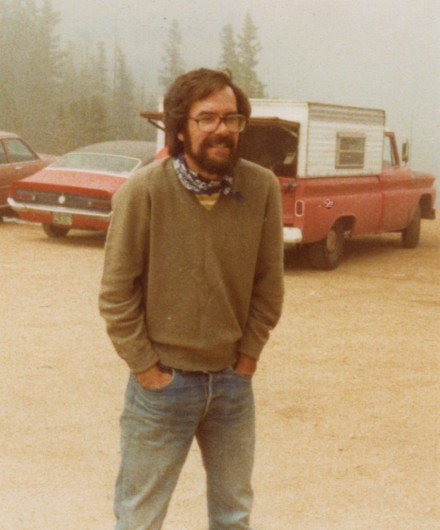
Jack Galvin atop o Berhoud Pass. January, 1978
The chemo killed the brain cancer but it also savaged your immune system. Scott K tells me it is unlikely you’ll make it through the night. If I could, but I can’t, I’d write a song or a poem in your honor, one that does justice to your humane spirit about to be extinguished, your talent as an organizer, your ability to see through so much bullshit that permeates the left, then and now, and get to the core of things, your humanity.
And you’re not even from New York and still you seem to have that same kind of `built in shit detector’? Impressive. How could you see so clearly? much more so than me. And together, we made music …politically and on that indescribable level of solidarity that people rarely achieve. companero. a little bit of me dies with you for you are a part of me, even so far away, even if you and patty left denver 20 or so years ago. It matters little as we both branded each other’s souls with our spirits – you me, me you…we weren’t `co-dependent’ – just a team.
In the late 1960s, Jack Galvin along with a dozen others, marched into the Colorado legislature and `sat in’ to protest the war in Vietnam. Among them was our mutual old friend Roberto Trujillo, chair of the Colorado Communist Party (CPUSA), even then a little thing, shadow of what had been a significant social movement in the state years earlier. Jack was studying to be a priest, Patty Seal – his life long soul partner – was studying to be a nun. In love, he quit the priesthood, she the nunnery and they began a love affair and mutual commitment to each other that will defy time, forged in love, passion and a life time commitment to one another that weathered everything imaginable.
In a world where things fall apart, it endured. They lived in the `Race Street’ Commune – one of the three or four political communes in Denver in those days, a home that brought together a variety of extraordinarily talented organizers for left and peace movements here in Denver in the decades that followed. Beyond that, it was such a fun place to be. `Good vibes’ as we use to say, even if like other left collectives it exploded into a thousand tiny pieces because no one could agree about who would do the dishes or some such issue, with its members going hither and yon. Matters little…for one shining moment..as the schmaltzy songs goes..there was magic. A wooden `radiator cover’ , my `inheritance’ from Scott Keating, who also lives there, sits in my basement as a kind of coffee table. A constant reminder
The morning that our (Nancy and my) first daughter, Molly was born now 30 years ago, one of the most joyous days of my life (the other being when our second daughter Abbie came along five years later), I went to see Jack and Patty. The birth had taken most of the night, in the morning after Molly was safe and sound in the world and Nancy resting, I left Rose Memorial Hospital and went to share my joy with friends if only for an hour. It wasn’t necessary to say much and I don’t believe I did. Just wanted to share the moment with them, no one else. We did talk a little, about the pros and cons of having children. I don’t remember what I said, only how extraordinary it was to see a daughter emerge and come into the world.
Jack had a particular sensitivity to and organizing potential for any issue involving racial discrimination. There are alot of white people who in their heart and soul oppose racism but don’t quite know how to work with people of color. That has always been something more difficult. Jack – along with my old friend Dick Ayre – were among the best I knew. The biggest event we ever organized together was after the Allende Government in Chile was overthrown with the connivance of that skunk Kissinger, now 34 years ago. I don’t remember much but I do recall we worked with Loretto Sister Pat McCormick, life long friend to us both and that 500 people came out to mourn the snuffing out of one of the more interesting and promising social experiments of the 20th Century. He also was a mainstay of the Radical Information Project bookstore on 17th Ave in NE Denver, one of the few enduring left institutions (although it no longer exists). He knew the score on the Middle East, understood the Israeli-Palestinian conflict in both its simplicity and complexity and always supported my work.
Why write about him? Because people should know his name. Those who inherit the earth, his son…all our sons and daughters should know that without him, the world would even be worse off than it was and that they too, if underneath it all, care about humanity and if they are really lucky and talented, can give to the world what Jack Galvin has. Good bye my friend. Your spirit will live on among us and your memory and contribution will give us strength for the struggles to come
With all my love. Rob Prince
 View from the Left Bank: Rob Prince's Blog