Trump’s European Trainwreck…1

Rather than revealing Washington’s strength, “making America great again,” Donald Trump’s European tour is more of an ongoing political train-wreck, a glaring example of the limits of Washington’s power as he bulls his way from Brussels to the outskirts of London, to Helsinki where he will rendezvous with Vladimir Putin in a few days. Everywhere he goes angry demonstrations – 250,000 demonstrating against him in London, thousands already in Helsinki, etc. The London anti-Trump protests are being described as the largest since the end of the Iraq War and the largest protests ever against another world leader.
Certainly on a public relations scale he’s at rock bottom.
But not so fast.
What is it that he tried to accomplish in his meetings in Brussels, and Great Britain, and how successful was he? As usual all the media buzz tends to cloud unfolding dynamics, not all of which are clear, but some of the main themes are starting to come into focus. In a nutshell, Trump’s goal in the Brussels and Great Britain stages of his European tour is to fan the flames of division. He did just that, to deepen the tensions within the European Union, to keep Europeans fighting among themselves. Read more…
Nuclear Notes – 5 – More Accidents of Radioactive Waste – Rocky Flats Nuclear Pollution Lives On In Idaho, New Mexico
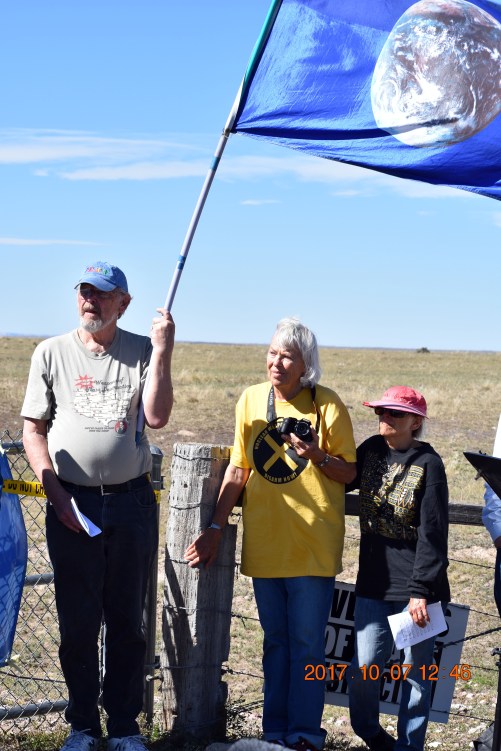
Protesting the 49 on hair-trigger nuclear missile sites in Colorado., October 07, 2017. This at N-8, a Minuteman Missile site outside of Raymer, Colorado. Left, Bob Kinsey, of the Green Party and Colorado Coalition for the Prevention of Nuclear War. Center, Judith Mohling of the Rocky Mountain Peace and Justice Center out of Boulder. I don’t know the person on the right in the black shirt and red hat.
Nuclear Notes – 5
Once upon a time – thirty years ago – there was a powerful popular movement aimed at derailing both nuclear weapons and nuclear power. Today it has shrunk to naught, or nearly. We need a national movement to cut the military budget, transfer the funds to human needs, press our government to once again seriously engage in international negotiations for nuclear disarmament, and stop with feeding the population the illusion that there is a technological fix that will make nuclear energy safe. “Gaseous Ignitions” are radioactive explosions.
As the time when the Rocky Flats Wildlife Refuge opens to hikers and the like – this despite widespread public opposition and outcry of the possible-to-probable remaining radiation dangers, stories of Rocky Flats related radioactive contamination are again in the news. A news story in the latest Spring, 2018 edition of Nukewatch Quarterly a nuclear weapons and energy watchdog publication out of Luck, Wisconsin, has an article by John LaForge, the publication’s editor, entitled “Rad Waste’s ‘Gaseous Ignition’ & ‘Exothermal Events’ are explosions.” Read more…

2012. Kristen Iversen, author of “Full Body Burden: Growing Up in the Nuclear Shadow of Rocky Flats” talking about her then about-to-be-published book in a bookstore in Lakewood Colorado. As I recall, several former Rocky Flats employees were present who reacted positively to Iversen’s commentary.
Nuclear Notes – 4
Nuclear weapons and nuclear war manufacturing and planning have been a part of the Colorado landscape since the end of World War II and dawn of the nuclear weapons age. The 49 Minuteman III missiles on hair-trigger alert in Colorado’s northeast, the state is home – or was home – to other aspects of the U.S. nuclear weapons complex. Just outside of Colorado Springs, 75 miles south of Denver, lies the Cheyenne Mountain Complex and Peterson Air Force Base, the latter now the headquarters of NORAD. Although not part of the nuclear weapons complex, at two lesser known sites on Colorado’s Western Slope, Rulison and Rio Blanco, underground nuclear blasts took place (Rulison-1969, Rio Blanco – 1973) Then there is the Air Force Academy, just north of Colorado Springs, that among other things, trains many of the pilots that will someday after graduation fly nuclear-weapons bearing bombers.
“Rocky Flats,” he told them, “is the largest unlicensed nuclear burial site in the United States.” – Jerry St. Piedro, former Rocky Flats employee, one of the few to see a map where much of the radioactive contaminated materials are buried at the site. (Quoted in “The Struggle To Remember the Nuclear West” by Hannah Nordhaus, High Country News. February 17, 2009)
Rocky Flats: Colorado’s Contribution to Environmental Pollution Read more…
Colorado’s 49 Nuclear Weapons on Hair Trigger Alert…and a Drunken Air Force General in charge of 450 Land-based ICBMs.
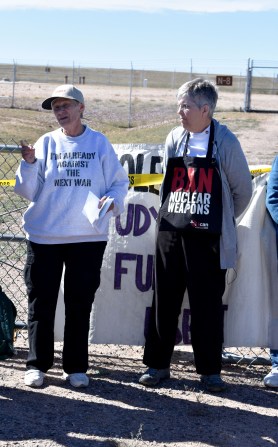
Sisters Ardette Platte and Carol Gilbert at N-8, a Trident III nuclear missile site where a protest against the nuclear arms race took place, October 7, 2017
Nuclear Notes – 3
N-8, One of Colorado’s 49 nuclear missile silo sites.
They go up there once a year.
“They” are people from a number of groups whose concern from the dangers of nuclear have never wavered, even though the issue has faded from the front pages and hardly makes a ripple anymore. They include Coloradans active in the Green Party, the indomitable Sisters of Loretto, and their circle of supporters, the Rocky Mountain Peace and Justice Center out of Boulder, folks associated with the Colorado Coalition for the Prevention of Nuclear War and a few associated stragglers like myself. The people involved are knowledgeable and committed, overwhelmingly pacifist, many religious. They are also among those who do annual events marking the U.S. atomic bombing of Hiroshima and Nagasaki here in Denver that Nancy and I try to attend when possible.
“There” refers to a nuclear missile site just west of New Raymer, Colorado, called “N-8,” one of 49 sites in N. E. Colorado with Minuteman III missiles on hair-trigger alert, that are of the 300-500 kiloton magnitude – The Hiroshima bomb was 20 kilotons by way of comparison. Colorado’s 49 nukes are part of a larger system of land based nuclear missiles that includes 450 of these death machines scatter among seven, states, mostly in the northern Mid Western states of Colorado, Wyoming, Montana, North and South Dakota, Nebraska as well as Missouri. Read more…
Chernobyl Fires, Then and Now – 2 – “The Silent Summer”

Six legged deer, one of many mutated animals from the post-accident Chernobyl exclusion zone
Nuclear Notes – 2
The area of a terrible nuclear accident, now safe for animals and people?
Over the years, largely because I visited the place long ago, (see Chernobyl Fires, Then and Now – 1), I have checked in with the developments at the Chernobyl nuclear power plant in the Ukraine that exploded as the result of an accident on April 26, 1986. The top of Chernobyl’s Reactor Four was blown off, releasing 400 times the amount of radiation from the Hiroshima bomb into the atmosphere.
The explosion contaminated significant areas of the northern Ukraine, Belarus, Poland and much of Europe. The United Nations estimated that over the next twenty years some 600,000 people died from Chernobyl related negative impacts (cancer, leukemia, circulatory and other chronic diseases). There are other estimates suggesting that the figure is greater yet, surpassing a million victims. Read more…
Chernobyl Fires, Then and Now – 1
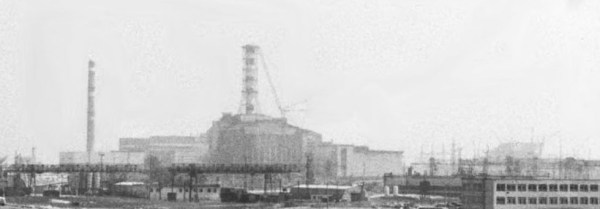
Chernobyl Nuclear Power Plant, April, 1989. (R. Prince photo)
Nuclear Notes – 1…Chernobyl
1.
A few weeks ago brush fires were reported to have spread not far from the decommissioned and contaminated Cherobyl nuclear power plant in Ukraine. According to Agence France-Presse, one broke out in the grass some six miles from the plant well within what is referred to as “the exclusion zone” – the heavily contaminated area of some 1000 square miles surrounding the plant.
The fire started on June 4, 2018. Three days later, by June 7 Ukrainian authorities reported that the fire had been extinguished and that radiation levels throughout the region had not acceded “acceptable levels.” They did not say however whether the radiation levels, even with in normal bands, had increased as a result of the fire nor what is included within the framework of “acceptable levels.
Nor is this the first time fires have erupted in the area. Similar brush fires broke out in June of 2017 and a much larger conflagration took place in April 2015. According to a Facebook post from Ukrainian Prime Minister Volodymyr Groysman, also quoted by AFP, “There’s no need to worry.” Groysman asserted that the radiation levels there remained within safe limits. Ukraine’s nuclear industry regulator said nothing untoward had taken place inside the former nuclear power station, which is not at risk from the flames. Read more…

The totals are horrific – As Gaza Palestinians protest peacefully against the moving of the U.S. embassy to Jerusalem, and for an end to the 12 year Israeli-Egyptian blockade that has made life all but unlivable, they are massacred by Israeli military snipers while Israeli citizens watch from nearby heights, cheering on the snipers as if they, the “audience’ were watching a soccer match. After six weeks of peaceful Friday protests, more than 120 Palestinians dead and an astounding 12,000 wounded. The Trump Administration blames the victims, the Palestinians – with the usual nonsense that Hamas had engineered the protests. Global outrage outside of the United States. Within its borders, predictably, hardly a peep from those in power, the media.
Tonight’s Program:
1. Summary of what we want to talk about on this evening’s program…
– the opening of the U.S. embassy in Jerusalem contrasted with the Israeli repression – massacres actually – of Palestinians peacefully protesting that, along with the 12 year blockade of Gaza that has made the place unlivable for its some 2 million people.
2. The U.S. role.The relationship of the Jerusalem embassy move and the Gaza protests to the events in Syria..
3. Then we will come back to the situation of the Palestinians in light of geo-political shifts in the region.
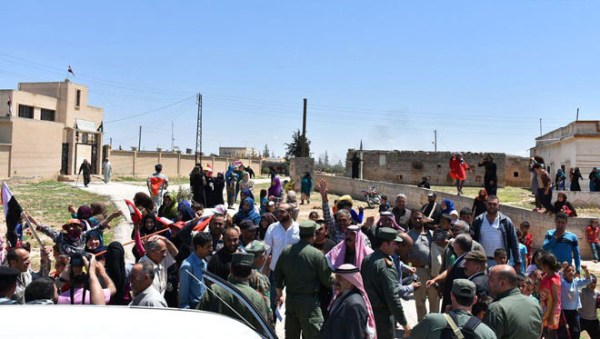
May 15, 2018. Citizens and Syrian Army militants celebrating the liberation of villages in the Hama-Homs region of Syria from ISIS-al Nusra like forces.
It was back in nineteen forty-two,
I was a member of a good platoon.
We were on maneuvers in Louisiana,
One night by the light of the moon.
The captain told us to ford a river,
That’s how it all begun.
We were — knee deep in the Big Muddy,
But the big fool said to push on.
“Waste Deep in the Big Muddy” by Pete Seeger
Part Three: Interview continued. (Among other points, this section deals with Robert Ford’s testimony before the House Foreign Relations Committee on February 8, 2018)
Here we talk about Robert Ford’s recent testimony before the House Foreign Relations Committee where he makes the comparison, interestingly enough, with Vietnam. Because it doesn’t play well in Washington to openly admit that the United States lost in Syria, he doesn’t use terms like “defeat,” or “we lost” but basically his whole argument is “We (the U.S.) lost in Syria, what should be done now?” – Rob Prince
Rob Prince (continued): There are several other points here
1. The United States, Britain and France, without any consultation with the U.N. Security Council, are attempting to establish a new international order in which the United Nations is sidelined. With people like Pompeo, Bolton and Nikki Haley advising Trump, diplomacy has essentially gone out the window. Haley’s statement “We’re locked and loaded” sums up the Trump approach.
– Although they suggest – or are meant to suggest – American strength, such statements are not so much a sign of American strength but increasing American global weakness. That it has to continually rely on playing the military card – ie. bombing and killing people – rather than using diplomacy or economic negotiations.
2. One more point here, thinking about this bombing (the U.S.-French-British April 13, 2018 bombing of Syria) my thoughts wandered back to the end of the Vietnam War. The war had ended, the last U.S. marines were withdrawn from the U.S. embassy in Saigon by helicopter – as humiliating and vivid sign of the American defeat in that war as can be imagined. Read more…

A Hike at Heil Valley Ranch

Spotted Towhee – Heil Valley Ranch. Boulder County Parks and Open Space. May 9, 2018. (R. Prince photo).
Our last two hikes this spring were at Colorado state parks – Roxborough and Staunton – but today went to a Boulder County Parks and Open Space hiking area. We tend to try trails at lower elevations this time of year – 6000 – 8000 feet altitude – both because the winter snows have not yet melted higher up and because it is more agreeable to hike the foothills of the Rockies before the summer heat sets in from mid June onward and the rattle snakes come up from the depths to sun themselves.
The state parks have a $7 entrance fee, but the Boulder County Parks and Open Space hiking areas are free. The trails of both kinds are well maintained and quite lovely. Given that the national parks are victims of huge Trumpty-Dumpty era funding cuts, that the state and county parks are well maintained especially here in Colorado (and less known) seeking out these places to hike and explore is worth the effort. Besides, I am continually startled – having lived in Colorado for a shade less than fifty years now – how much more there is to explore, and how little of the state I know…as one who has hiked its mountains and plains all year round during this half century. Read more…
A May Day Poem about Education, Kaivoksela Finland and Mapleton Colorado by Molly Prince

Paivi Karkkainen – one of Molly’s teachers in Kaivkosela, Finland (years later)
I was at the capitol on Friday with a few thousand
teachers and paraprofessionals
and their supportive friends and allies.
It was a beautiful sea of red.
And I found myself remembering
something my teacher said to me
In 1988.
in my class,
where I was the only dark haired girl in a sea of blondes.
Because I was in a somewhat unusual
situation
for a little American girl.
My classroom was in a
Finnish public school
in Helsinki, Finland.
My teacher,
Regina Vesola,
told us
That a nation can be judged
by
how it treats its young and its old.
The class swelled with pride
when she told them Finland’s
ranking for
how they take care of their
children.
I wish
I could swell with pride
about the way
Colorado
takes care
of its children.
However,
at my school
last year
we
literally
had shit running
down the hallway.
A sewer problem
that every year
was
supposedly fixed
but kept coming back
in different
forms.
One year
I was teaching
a reading lesson
to a couple of
fourth graders.
They were sitting at my
kidney shaped
teacher table.
Ms Prince,
it smells like poop,
one of them said.
Why yes,
I realized.
It does.
taking the class
outside
to escape
sewer smells
started to feel
like a
regular
part
of
the routine.
Good news.
A new building
is under construction
this very moment
and
next Fall
kids and teachers
will be in a new building.
With.
-we assume, we hope, we cross our fingers,
no
sewer smells.
How did this happen?
It was a collaborative
effort
but our
local teachers’
Union
helped.
Our local
teachers’
union
organized
going door to door
knocking
asking people
to vote yes
on the bond.
The bond passed by
(dramatic pause)
45 votes.
People who don’t want
to join the union
tell me
about ways it is imperfect.
I don’t claim that
its perfect.
Nobody is.
But
the teachers union
is a powerful force
for good
for teachers and
students.
So, if you are a teacher
and have
the opportunity
to to join the teachers union
I hope you will.
Teaching, even when its good,
is exhausting work.
Teaching in impoverished schools
takes a toll
on a person’s
health
and on their spirit.
My acupuncturist tells me
he see tons of teachers
for insomnia.
A therapist friend tells
me she has numerous
stressed out melting down
teachers as clients.
I’ve lesson planned for hours
on Sundays for
17 years.
I decided not to do the math
about how many hours that adds up to.
And there is also so much I love
about teaching.
So much that is beautiful
and rewarding.
Something that gives me hope
is initiative #93
that teachers unions and superintendents
among others are
working to get on
the ballot
this November
that would increase funding
for all Colorado schools
and would especially
benefit the
poorest ones.
Here are a few of the things I want
when I say I want more funding for schools.
I want students in all schools to have music
and art and libraries.
I want the students
with the highest
needs to have
their needs met.
I want students to have engaging resources
and
Teachers who come back year after year
and hone their craft
until they are master teachers.
Because the conditions and the
pay make it desirable….
Mapleton, Colorado school bond campaign…2017.
A Hike in Staunton State Park

Batholith formations at Staunton State Park near Conifer, Colorado
Staunton State Park
Last week it was Roxborough State Park south of Chatfield Dam, 25 miles or so south of Denver along the foothills through Dakota (100 million years ago) and Lyons (280 million years ago) formations. It was in a well watered area at the edge of the foothills at an elevation of 5000 feet. There were some wetland areas right at the edge of the foothills between the Dakota and Lyons formations. The bird and animal life were extensive but in terms of what we saw (deer, a variety of bird species – and what the rangers told us were in the vicinity (bear, mountain lion, bob cat had all been cited within a week or so of our visit.)
Today’s hike was quite different
We were up in the mountains at around 8500 feet, west of Conifer at another state part, Staunton State Park in a pine and aspen forest with all kinds of rock outcroppings, batholith formations, a part of the Pikes Peak complex – although a good 60 or 70 miles north of the peak. Read more…

Douma, Syria – a Damascus suburb liberated by the Syrian Army from ISIS, al Nusra forces this year, in 2018, the site of the latest false flag operation giving Washington a pretext to launch a missile attack against Syria
KGNU – Hemispheres, Middle East Dialogues. April 24, 2018 – Part Two
__________
__________
Part Two
The more the situation is probed, whatever was intended, the attack turns out to be nothing more than a gratuitous and racist display of fire power, violence. Rather than accomplishing anything concrete from a military viewpoint, it was more of a symbolic gesture, reminding the world that the United States has a sophisticated military arsenal – more so than any other country in the world by a long shot – and that it can and will use them whenever Washington sees fit. So certainly rather than “mission accomplished” as President Trump claimed, Shakespeare’s quote seems to sum up the operation: “sound and fury signifying nothing.”
Ibrahim Kazerooni: (continued). But to answer this question (was the mission accomplished” or was it just “sound and fury signifying nothing”) let’s go through various scenarios that have presented as an explanation for “why this attack?”
Number One: First of all, looking at the maps where both Russians and Syrians assert the United States focused on bombing, a certain picture becomes clearer. First the northeastern region of Syria was targeted as well as the far southern area of the country.
In both of these areas, the mercenaries are being pushed hard by the Syrian army and they are being continually routed out one after the other.
So “Number One Scenario” is that the reason for the bombing is to help the rebels (mercenaries) stabilize their positions and escape from the onslaught of defeat at the hands of the Syrian army. These bombings did not target ISIS, al Nusra but it is the Syrian army that was attacked. This scenario fits what the United States has been doing in the past – repeated attacking the Syrian or Iraqi army – whether in Iraq or Syria – to give ISIS or al Qaeda be able to run or re-organize with the key military planners (of ISIS, al Qaeda) withdrawn to fight another battle. Read more…
The Tripartite Attack on Syria: “Mission Accomplished” or “A Tale Told by an Idiot, Full of Sound and Fury Signifying Nothing?”

Naples’ mayor Luigi de Magistris said the U.S.S. John Warner, a nuclear submarine, is not welcome in the city. Cruise missiles from this ship were fired at Syria in response to false flag claim that the Syrian government had used chemical weapons against civilians.
(note: This interview on KGNU Boulder dealt with the U.S.-U.K-French missile attack on Syria in response to an alleged use of a chemical weapon attack by the Assad government on Syrian civilians. All the evidence up until now suggests that the whole incident was fabricated. If this was the case, and more and more evidence suggests it is, then why bomb Syria? These are the issues that were dealt with in this hour-long program. Because of the length of the interview, it will be posted in chunks.)
The 103 missile attack in protest to the Syrian chemical weapons attack that didn’t happen
…all the evidence suggests that there was no gas attack. (Robert) Fisk went there (to Douma, Syria) as well as three or four other groups of reports, both European and from Russia. All of them, independent news sources, have unanimously reported that, after having gone over there, interviewed different people, gone to the hospital where supposed the victims are recovering, all of these reporters clearly state that there was no chemical weapon or gas attack at Douma. The whole incident was contrived. It didn’t happen.
Ibrahim Kazerooni on KGNU, Hemispheres, Middle East Dialogues.
KGNU – Hemispheres, Middle East Dialogues. April 24, 2018 – Transcript, Part One.
Jim Nelson: So let’s move onto this evening’s topic which many of our listeners would have guessed we’d cover tonight. It concerns the bombing that happened last week, on Friday, April 13, Friday the 13th! against Syria. After it was finished, Trump proclaimed “mission accomplished.”
So gentlemen, you are going to explore whether “that mission was accomplished..or was it `sound and fury’ or what?” Meanwhile look at the awful situation in Syria, Yemen. And I think Rob is going to open up
Rob Prince: Yes, it’s the case that after the bombing that President Trump declared “mission accomplished” – a term we’ve heard in the past; George W. Bush used the same expression after the U.S. led invasion of Iraq.
Jim: The way that Trump tweeted “Hey, this mission has been accomplished” suggests he was referring to the Bush statement.
Rob Prince: Our question is “What was the mission? And what was accomplished/” but we’ll address these questions later in the program. Read more…
Syria and Trump’s Brinkmanship Foreign Policy: New Focus – Destroying the Joint Comprehensive Plan of Action (Iran Nuclear Deal)

John Kerry and Mohammad Javad Zarif named winners of the Chatham House Prize 2016 for the signing of the Joint Comprehensive Plan of Action (Iran Nuclear Deal)
A serious, objective look at Obama’s Middle East policy is rather sobering: despite personal tensions between Obama and Israeli Prime Minister Netanyahu, some of the largest arms sales and grants in U.S. history to Israel. Obama did nothing to stem continued expansion of Israel’s illegal West Bank settlement program or lift the increasingly suffocating and inhumane Israeli (and Egyptian) stranglehold on Gaza. Obama ok’d (he says he later regretted it) the military campaign to overthrow Khadaffi in Libya – strongly encouraged by his then Secretary of State, Hillary Clinton – which has both destroyed Libya as a nation and spread instability throughout the northern half of Africa. During the Obama years Hillary Clinton’s major contribution to Middle East peace – or the lack of it – was gazillion dollar arms sales to Saudi Arabia, Kuwait and the emirates and calls to overthrow the Iranian government. All the above are facts, easily corroborated by anyone wanting to take the time to verify them.
There were two exceptions to this sorry and confused record for which Barack Obama deserves credit:
1. When pressed to attack Syria with cruise missiles after the rushed and unverified claims that the Assad Government had used chemical weapons against its own people, Obama refused to give into the war hysteria (as Trump just did on April 13) by bombing the country. Those allegations proved to be fabricated. Obama held the line despite outcries from neo-conservatives and the likes of AIPAC. A moment of political courage
2. Obama’s attempt to normalize U.S. relations with Iran, through the signing of the Joint Comprehensive Plan of Action, known in the U.S. – and mistakenly as simply “the Iran Nuclear deal.” It was an attempt, however brief to use diplomacy over military options and we should not be surprised that on the U.S. side it was engineered by a Secretary of State, John Kerry, who a half century prior, threw his military medals over the White House fence along with other members of Vietnam Veterans against the War, who opposed the U.S. war in Vietnam.
But whatever minor steps were taken by Barack Obama are now being swept away by a presidency in which all diplomacy carries with it the threat of military action. I suppose that is not so new – the threat of military action as a mechanism for diplomacy has long been a part of U.S. foreign policy – Henry Kissinger wrote a book about how the U.S. nuclear arsenal could be used to blackmail countries into towing an American line – but today such threats are being used more crudely than ever, dangerously so, and to such a degree that one could say that Washington has no other foreign policy than brinkmanship – the threat of military action.
Trumpty-Dumpty’s Global Brinkmanship and the Joint Comprehensive Plan of Action (Iran Nuclear Deal) – Some Middle Eastern Critiques of the Agreements.
So…now Trumpty-Dumpty’s brinkmanship policy changes focus once again, from N. Korea, to Syria, now to Iran and supposed negotiations with N. Korea. The focus bounces blindly back and forth. Now there is a new twist…as Washington pursues peace talks with North Korea (however cynical) while at the same time threatening Iran. The peace talks with North Korea will overshadow the increasingly aggressive approach to Iran, at least in the U.S. media and of course, the generally brain dead U.S. Congress where bipartisan support for overthrowing the Iranian government remains significant. On May 12 of this year, the Trump Administration will decide whether to continue in the agreement or not.
Trumpty-Dumpty is milking the uncertainty of his decision for all its worth. My sense is that, despite the rhetoric, he’ll stay in the agreement but find other ways to undermine it or make it essentially moot, but we’ll see soon enough. Regardless a policy of gradual conciliation has been replaced with brinkmanship and threats…the usual U.S. policy towards its global adversaries.
Yesterday there was (for me) a fascinating exchange of views concerning the Joint Comprehensive Plan of Action (known in the US of A as the Iran Nuclear Deal). It was my impression that most of the comments came from people from the Middle East, many of them Iranian. I was surprised how many of them – as they virtually appeared to be “progressive” – whatever that might mean – were either critical or quite cynical about the deal. Many of their comments were insightful. These folks know what they are talking about and frankly, if not for these exchanges, I would not be on Facebook as I can always send family pictures, and bird photos to my relatives. I don’t need Facebook to do this.
As one who supports this agreement – did in the past and will continue to support its implementation – I had to think about the arguments presented…because they were not flakey in nature. Thought about it most of yesterday.
The main argument given was that in signing the accords, the Iranians gave up far more than they got. …ie, that it was not the U.S. that signed a bad agreement, but the Iranians themselves. They have a point. If you look at the agreement closely – it is not the U.S. that had to give ground, make major concessions but Iran. They have all but given up control of their nuclear energy policy, agreed to submit to inspections – there is nothing in the agreement that makes the other parties do so, forced to follow strict timelines, etc. etc. In fact, the more one looks at it, the more punitive against Iran that the agreement appears and one can understand why there was opposition to it in Iran – and not just from conservatives and the military.
Supporting the Joint Comprehensive Plan of Action in the Age of Trump.
Then why support it? Wouldn’t it be better for both sides if the agreement is scrapped and that some of Trumpty-Dumpty’s rhetoric actually rings true?
Scrapping this agreement would be a very dangerous move, both for Iran, for the Middle East and one that would only escalate the nuclear arms race. There are also indications that rather than isolating Iran by so doing, it would isolate the United States.
What is accurate about the criticisms made is that the agreement IS lopsided; the Americans (the Obama Administration that signed it) get far more than they give; Iran gives far more than it gets. But………
1. This reflects the current balance of power in the world. Iran is not going to able to impose its conditions on the United States. The United States still has the power to impose – with limits – its will on Iran. So it is Iran that simply had to make the concessions. Still, the fact that the United States and its allies had to negotiate AT ALL with Iran, and give something back in return – which it then quickly took away (an end to sanctions) suggests a shifting balance of power in the world. By signing this treaty, the United States (and its allies) were forced to admit Iran as a legitimate force in the Middle East region. This is no small thing concession from Washington that has thought for seven decades that it could simply dictate policy. It can’t anymore. Washington had to negotiate its grievances…it could not just bomb them out of existence. By the way, this remains relevant today. It is not so simple for the U.S. – one way or another – to attack Iran.
2. More importantly, it gave Iran a certain amount of breathing time. If the economic fruits – the contracts Iran was able to sign after the deal was reached – were not as extensive as they had hoped – because of U.S. pressure to re-institute sanctions in violation of the agreement – still, they were considerable with many countries. Iran’s place on the Belt Road Project is pretty much assured and likelihood of growing cooperation with some of its neighbors (Turkey, Pakistan, even India) to say nothing of improved ties with Russia, China and to some extent Europe all fruits of the agreement.
3. Finally there is the historical perspective that needs to be remembered here. There are MANY examples – classic examples – of negotiations in which major concessions were made – based on the political realities of the time – to buy time. To mention just a few.
• After the Russian Revolution of 1917, Lenin immediately made peace with Germany. Russia made major territorial concessions, but it got breathing room – the space to consolidate the revolution.
• Likewise, to a certain extent, when, after Britain and France refused to enter into an alliance with the USSR to fight German fascism, Stalin signed the Hitler-Stalin pact – by which the USSR had to provide strategic war materials to Nazi Germany, Stalin, like Lenin was buying time. In that narrow window of two years prior to the onset of Operation Barbarossa the Soviet Union engaged in a massive industrial build up in the Ural Mountains, which was probably decisive in its herculean effort to defeat Nazism.
• Finally, there were Gorbachev’s concessions to the West in the late 1980s – unilateral disarmament and withdrawal from Eastern Europe leading to the collapse of communism in those countries. Again, the U.S. and its allies were in a much stronger position than the Soviet Union. Gorbachev understood that the economic and political reforms he saw necessary to modernize and democratize Russia required time – a great deal of time, probably decades. He was willing to make what were major strategic concessions – tone down the Cold war – to concentrate on remodeling the country. Yes, the reforms failed and the USSR collapsed, but from where I am sitting – that was the gamble that Gorbachev was willing to take and he took it. That took political courage and foresight.
For all its admitted limitations, from where I am sitting, the Joint Comprehensive Plan of Action fits into the same general category. Frankly it was a brilliant move on Iran’s part – nothing less, and the more I think about it, what were the other options – increasing regional tension? bringing the region to the brink of war? It was also a victory – or maybe a step forward is a better way to put it – for those in the United States concerned about a U.S. foreign policy based on unending Middle East war – that such a policy serves U.S. interests as poorly as it does the countries in the region. It was a brief step away from the long pattern of military intervention that has destabilized the region and done such harm. That this opening has been so brief – actually fleeting – cannot be laid at the doorstep of Teheran.
But now that good will has all but evaporated as the Supreme Court appears likely to approve Trumpty-Dumpty’s bigoted travel ban, targeting Middle Eastern countries, including Iran with a Congress almost foaming at the mouth to add sanction upon sanction against Iran – in violatioon of the agreement. In today’s hostile environment there is no better way today for opposing the drift towards war, no way of trying to throw a money wrench in what is a new and more dangerous round of a nuclear arms race than to preserve the Joint Comprehesive Plan of Action…despite its limitations.
 View from the Left Bank: Rob Prince's Blog